
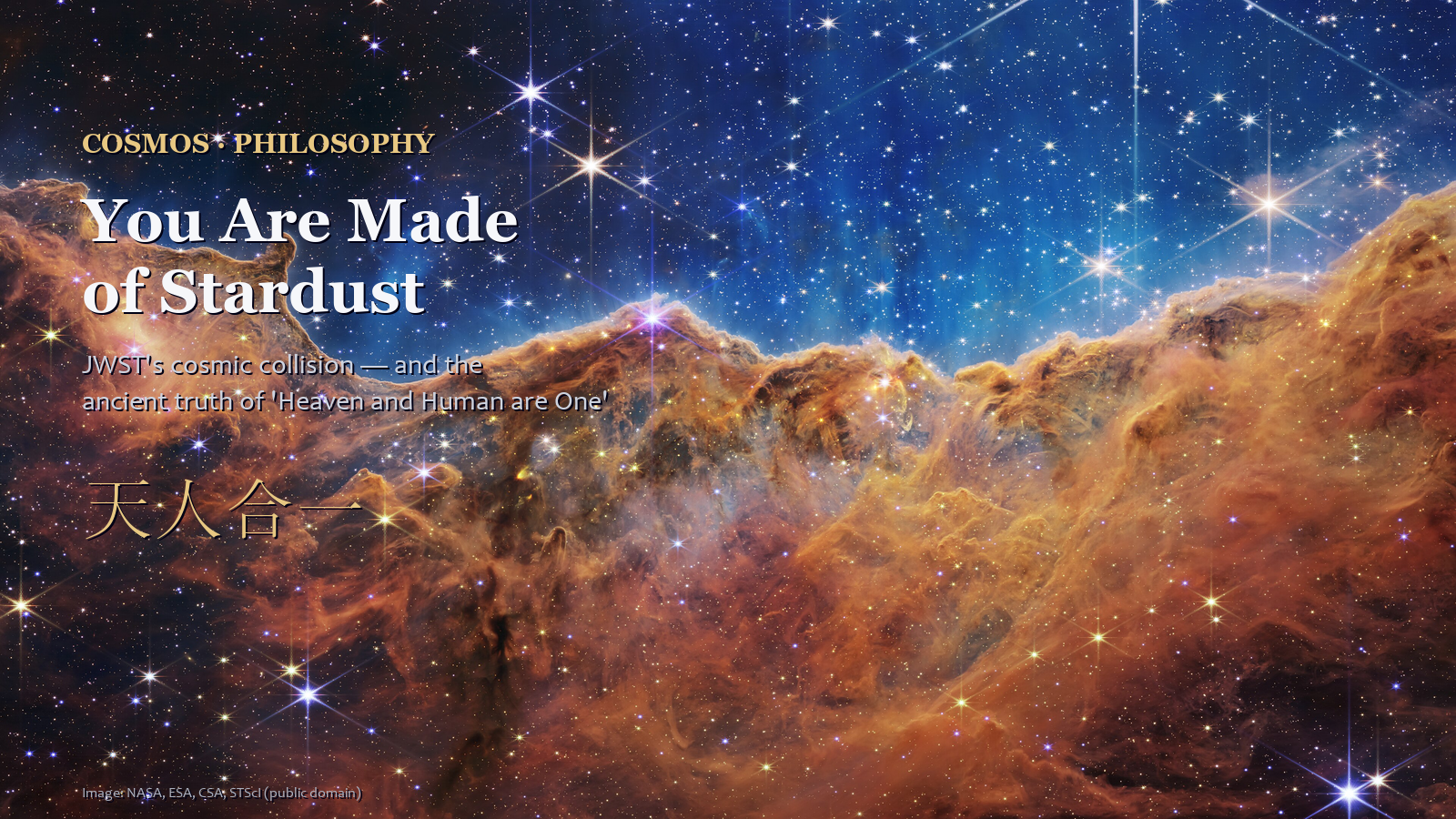
The calcium in your bones, the iron in your blood, the oxygen you are breathing right now — all of it was once a star.
In 2026, the James Webb Space Telescope captured a startling scene from just 800 million years after the Big Bang: at least five galaxies colliding. More striking still, that collision was scattering heavy elements — forged inside stars — out into the surrounding cosmos. For the first time, humanity watched carbon, oxygen, and iron being flung across space.
Why does this concern you? Because those scattered elements would one day become planets, oceans, and finally you.
“We are stardust” is not poetry — it’s an inventory
Apart from hydrogen and helium, nearly every element in your body did not exist in the early universe. Each was forged in the vast furnace of a star’s interior over millions of years of fusion. And when stars died in explosions — or when galaxies collided, as JWST just witnessed — those elements spread outward into space.
That dust gathered again into a sun, into an Earth, and Earth’s elements became water, air, and life. Every carbon atom in your fingernail, every iron atom in your blood, was made in the heart of some star billions of years ago. As the astronomer Carl Sagan famously put it, “we are made of star-stuff.” That is not a sentimental metaphor; it is a physical fact, confirmable atom by atom.
天人合一: Heaven and human are one
Yet the East intuited this truth 2,300 years ago — with no telescope and no periodic table. Zhuangzi wrote:
“Heaven and earth were born together with me, and the ten thousand things and I are one (天地與我並生, 而萬物與我爲一).”
— Zhuangzi, “Discussion on Making All Things Equal”
The core Eastern idea of tianren heyi (天人合一) — the oneness of heaven and human — is often dismissed as mysticism. But seen from the cosmic perspective JWST reveals, it is astonishingly literal. You and the universe are not two separate beings but one continuum, joined by shared material. The atoms in your body and the atoms of a distant galaxy are siblings from the same stars.
物化: the ceaseless transformation of things
Zhuangzi goes one step further. The final word of his famous butterfly-dream is wuhua (物化) — the endless transformation of things.
The atoms that make you are not the fixed property of some permanent “self.” They were once a star, are now briefly gathered into “you,” and will one day scatter into soil, sea, and other lives. Not a single atom is yours forever. We are not possessions but borrowed forms briefly assembled — a knot in the great flowing current of the cosmos. Buddhism’s no-self (無我) and impermanence (無常) point to the same place.
道生萬物: from the one, the many
Laozi compressed this unfolding of the universe:
“The Way gives birth to one; one to two; two to three; and three to the ten thousand things (道生一 一生二 二生三 三生萬物).”
— Tao Te Ching, Ch. 42
The 13.8-billion-year story in which a single beginning unfolded into elements, stars, galaxies, and life. Laozi’s line reads almost like a compressed edition of modern cosmology. The ten thousand things are not scattered strangers but one family, branched from a single source.
So how, then, to hold this short life?
Here is why this is not merely an astronomy story. This perspective changes how we meet our own small life and death.
If you are the universe briefly taking form, then death is not annihilation but wuhua — a return to the flow. Zhuangzi could meet even his wife’s death with calm not from coldness, but because he saw life and death as natural change, like the turning of seasons. We are a moment in which stardust gathered and looked back at itself — and then returns to the cosmos. That fact offers not fear but a strange, spacious comfort.
Practice — living the day from a cosmic view
- Look up at the night sky. Simply knowing that starlight is your body’s homeland changes the scale of the mind.
- Measure a small worry against cosmic time. Within 13.8 billion years, today’s anxiety finds its true size.
- Cultivate connection. The sense that all things are one with you (天人合一) thins both loneliness and selfishness.
- Meet change as flow, not resistance. Through the eyes of wuhua, loss and aging are phases of a cycle.
Frequently asked questions
Is “we are made of stardust” scientifically true? Yes. Every element in your body beyond hydrogen and helium was made by stellar fusion and spread by supernovae and galactic collisions.
Isn’t 天人合一 just mysticism? Long treated as metaphor, it is close to literally true in terms of material continuity.
Does a cosmic perspective actually help daily life? Studies find that experiences of awe lower stress and raise generosity and life satisfaction. There is power even in looking up.
Thousands of years ago, Zhuangzi knew without a telescope that he and all things were one. Now the James Webb Telescope, in the collision of galaxies, shows the evidence of that oneness atom by atom. You are not a spectator separate from the universe. You are the universe — briefly wearing the shape of a person, looking back at itself.
Leave a Reply