
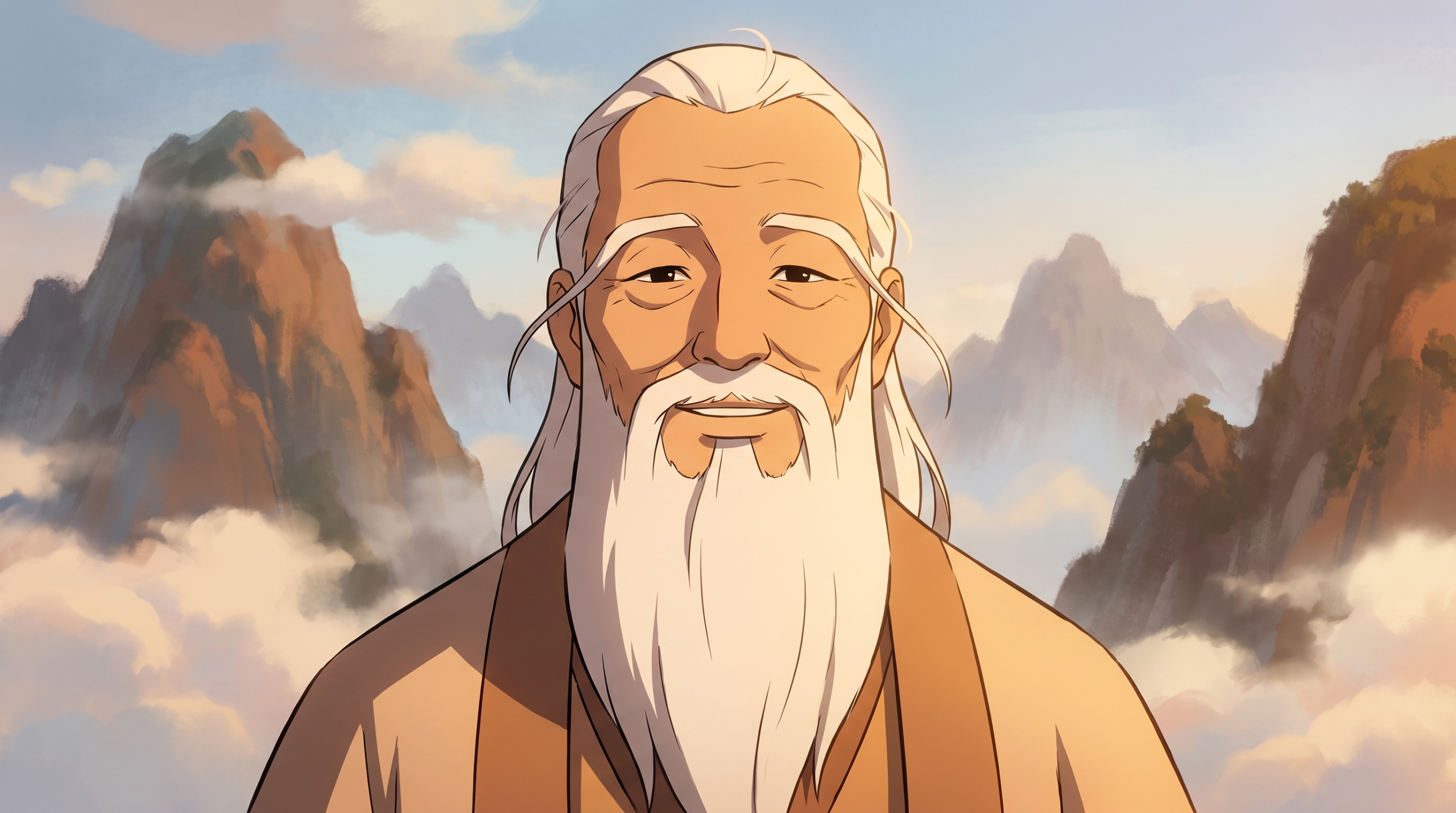
Twenty-five centuries ago, a quiet keeper of royal archives is said to have written just five thousand characters before riding west into the mountains, out of history and into legend. That little book — the Tao Te Ching (道德經) — became one of the most translated works ever written. Its author, Laozi (老子), still speaks with startling tenderness to anyone who feels the modern pressure to push harder, grind longer, and control more. His message, distilled: you are already closer to your true strength than you think.
The Dao: a current that is always with you
Laozi's central word is the Dao (道) — "the Way," the natural current flowing through all things, including you. You don't have to invent your path from nothing; there is already a grain to reality, and life becomes lighter the moment you stop fighting it. "The Way follows what is natural" (道法自然). To live well is not to force the river, but to learn its direction and let it carry you.
Wu wei: effortless, not effortless-less
His most misunderstood idea is wu wei (無爲) — often translated "doing nothing," but truly meaning effortless action. It is the ease of a skilled hand, the grace of water finding its way downhill. Wu wei is not laziness; it is the end of needless struggle. So much of our exhaustion comes from rowing against our own current. Laozi gently asks: what if you stopped?
Why water? Because softness endures
Laozi's favorite image is water: "The highest good is like water. Water benefits all things yet does not compete" (上善若水, 水善利萬物而不爭). Water looks soft, yet it carves canyons and outlasts stone — "the soft and weak overcome the hard and strong" (柔弱勝剛強). In a world that worships force, this is quietly revolutionary: your patience, your gentleness, your willingness to yield are not weaknesses. They are a deeper, more lasting kind of power.
The strength of knowing yourself
Laozi offers one of the most affirming lines in all of philosophy: "Knowing others is wisdom; knowing yourself is enlightenment" (知人者智 自知者明). You do not need to conquer the world to be great — you need only come home to yourself. And when the path ahead feels vast, he reassures: "A journey of a thousand miles begins beneath your feet" (千里之行 始於足下). The whole road is reachable, one honest step at a time.
A "Laozi personality" today
If Laozi is your sage, you likely value freedom, flexibility, and timing over force. You sense the larger current others miss, and you'd rather let a problem dissolve than wrestle it to the ground. Your calm is contagious; your perspective steadies the people around you. Your growth edge is gentle decisiveness — trusting that when the moment is right, one clear step is enough. You don't have to become someone else. You have to become more fully, more freely, yourself.
Try it this week
Choose one thing you've been forcing. Set the struggle down for a day, and ask: if I stopped fighting the current, what would the natural next step be? More often than you expect, the water finds the way — and so will you.
Do you think like Laozi — or more like Confucius, Mencius, or Sun Tzu?
👉 Find out in 2 minutes: Which Eastern Sage Are You? → Take the test now
📖 More sages & Eastern wisdom → Visit the blog · Our books → our books