
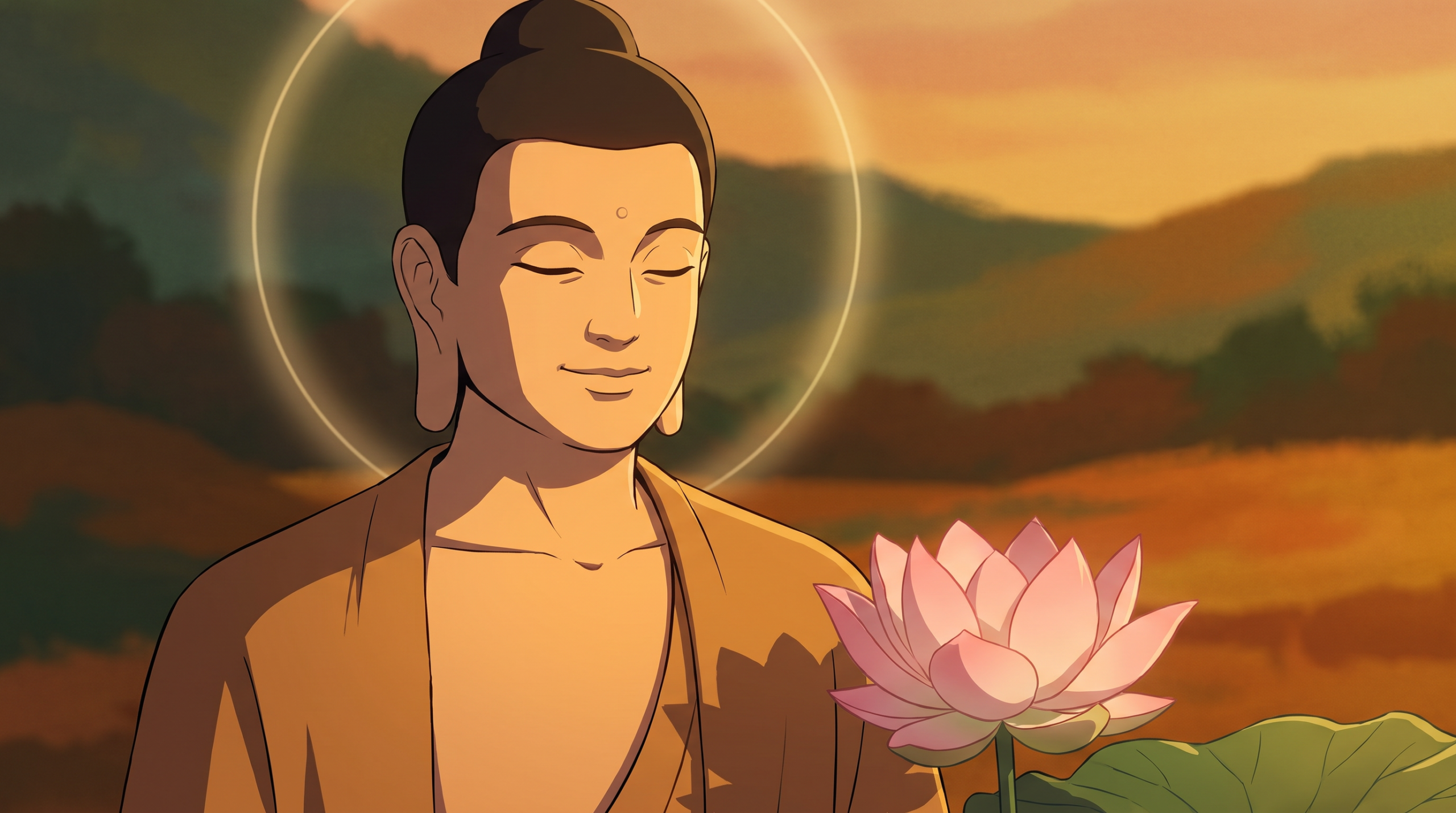
Born a prince, Siddhartha Gautama (佛陀) left palace comfort to answer one question: why do we suffer, and how can we be free? His answer, 2,500 years old, still steadies millions in anxious times. Its heart is gentle and hopeful — peace is not something you must earn or acquire; it is what remains when you set down what was never yours to carry.
Everything changes — and that's mercy
"All conditioned things are impermanent" (諸行無常). Nothing stays — not joy, and blessedly, not pain. When you truly feel this, hard moments loosen their grip: this too is passing. Impermanence isn't bleak; it's the reason nothing can trap you forever.
Suffering and the way out
The Buddha's Four Noble Truths are clear-eyed and practical: suffering exists; it arises from craving and clinging; it can end; and there is a path. That path is the Middle Way — not harsh self-denial, not endless indulgence, but a balanced, mindful life. Freedom comes not from getting more, but from grasping less.
The light is already in you
Perhaps his most encouraging teaching: "All beings possess the Buddha-nature" (一切衆生 悉有佛性). You are not a flawed thing striving to become worthy — you already carry an inner wholeness, a light that clouds may hide but never extinguish. Practice simply clears the sky.
A "Buddha personality" today
If the Buddha is your sage, you are calm, compassionate, and insightful. You seek peace over winning and can hold your center while others spin. Your strength is serenity; your growth edge is engagement — remembering that letting go is not the same as giving up, and that your steadiness is a gift the world needs you to share. The peace you look for is closer than it appears: it is already within.
Try it this week
Pause and breathe slowly three times. As you exhale, gently set down one worry you've been clutching. You're not forcing peace — you're uncovering the calm that was always there.
Do you think like the Buddha — or more like Laozi, Confucius, or Sun Tzu?
👉 Find out in 2 minutes: Which Eastern Sage Are You? → Take the test now
📖 More sages & Eastern wisdom → Visit the blog · Our books → our books