
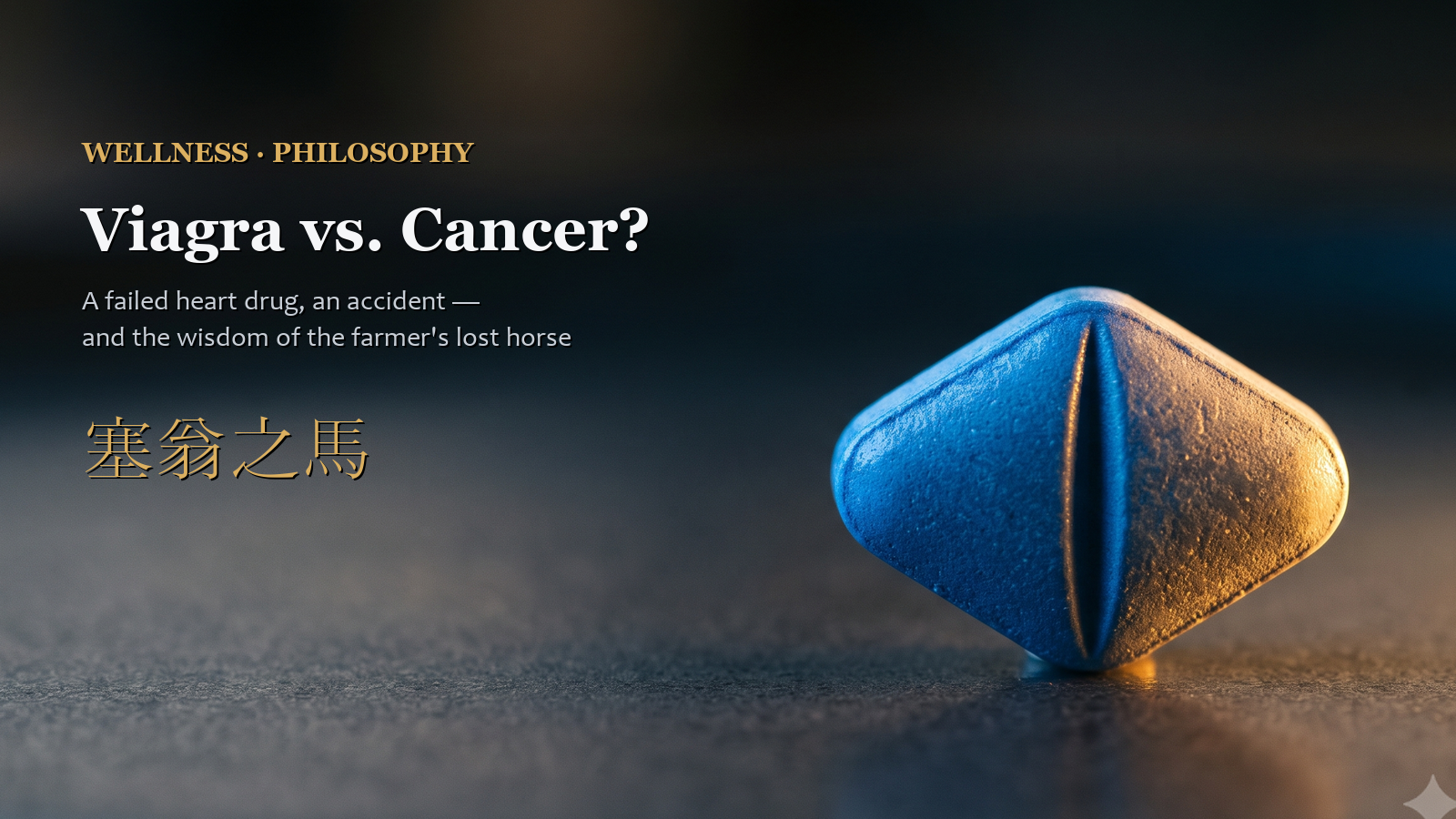
The most famous blue pill in the world is now in the cancer lab.
In 2026, a run of studies found that Viagra (sildenafil) — known as a treatment for erectile dysfunction — may help curb the spread of cancer. According to research in Cancer Research, sildenafil blocks cancer cells’ ability to use cholesterol, which those cells rely on precisely when they break away from the original tumor and invade other organs — the process of metastasis. It does this by inhibiting an enzyme called PDE5, raising levels of a signaling molecule, cGMP.
And it isn’t only theory. An analysis of Israel’s large Clalit health database found significantly better survival among cancer patients who had taken sildenafil, especially in combination with cholesterol-lowering statins. The researchers’ next step is a clinical trial giving the drug to women with hard-to-treat triple-negative breast cancer.
An ED drug as a cancer candidate. As absurd as it first sounds, this story carries an ancient piece of Eastern wisdom — the parable of the old man’s horse (塞翁之馬).
Viagra itself is a story of the farmer’s horse
Remarkably, the drug’s own life reads like a textbook case of that parable.
Sildenafil was not created as an ED drug. Pfizer developed it in the 1980s–90s as a treatment for angina — chest pain from heart disease. But in trials it disappointed for angina. A failure. Then male participants began reporting an unexpected “side effect.” We all know what it was. In 1998, sildenafil was reborn as one of the most famous drugs on earth.
- Developed as a heart drug → failed (misfortune)
- An unexpected side effect became a blockbuster ED treatment → triumph (fortune)
- Decades later, that same pill returns as a cancer candidate → another possibility (?)
One pill kept becoming something else. What counts as failure and what as success, what is the “real” use and what a side branch — none of it was fixed from the start.
塞翁之馬: fortune and misfortune are not fixed
The tale comes from the Huainanzi. An old man near the frontier lost his horse. When neighbors offered sympathy, he said, “How do you know this isn’t a blessing?” Soon the horse returned, bringing wild horses with it. When they congratulated him, he said, “How do you know this isn’t a disaster?” His son, riding one, broke his leg — and was therefore spared conscription into a war that killed many.
“In all human affairs, the old man’s horse.”
— Fortune turns to misfortune and back again, and the turning has no end.
Viagra’s journey is a modern edition of this fable. Without its “failure” as a heart drug, there would have been no ED treatment — and no cancer research today. What looked like failure opened an entirely different door.
無用之用: the use of the useless
Zhuangzi pushes further, speaking of “the usefulness of the useless” (無用之用). The gnarled, ugly tree the carpenter ignores survives precisely because it is “useless” — living long and casting great shade. What is useful and useless flips depending on the angle of sight.
Modern medicine calls this drug repurposing — discovering an entirely new use in a drug that already exists. Aspirin became a cardiovascular preventive; thalidomide became a myeloma treatment; now Viagra becomes a cancer candidate. The East knew the principle millennia ago: nothing holds one fixed use.
溫故知新: reviewing the old to know the new
And here is the teaching this blog takes as its name. Confucius said:
“Review what is old and know what is new — then you are fit to be a teacher (溫故而知新 可以爲師矣).”
— Analects, Book II
Many of medicine’s most dramatic advances came not from inventing something wholly new but from seeing what already existed with new eyes. The Viagra-cancer research is exactly that: not a new molecule, but a decades-old, familiar drug examined again — this time carrying a different question. Reviewing the old to know the new is not a study’s motto; it is a laboratory method.
⚠️ But — this is still a “possibility”
Let one thing be clear: do not take Viagra to prevent or treat cancer right now.
– The current evidence is mechanistic plus observational; the clinical trials that prove cause and effect are only beginning.
– The right dose, timing, and safety alongside other cancer drugs are unknown.
– Sildenafil interacts with blood-pressure and heart medications, so self-medicating is dangerous.
This is not “take Viagra.” It is a story of science and wisdom saying: the familiar may hold an unexpected answer.
A reflection — the farmer’s horse in our own lives
Does this apply only to a pill? In our lives too, what looked like failure opens unexpected doors, and a talent we treated as a side branch becomes the main work. Today’s misfortune may be tomorrow’s blessing; what seems useless now may be the very use we need later.
A little blue pill failed at the heart, succeeded where no one expected, and now goes to fight cancer. Perhaps its journey says this: do not be quick to call anything a failure — and look again, with new eyes, at what you already hold.
Frequently asked questions
Is Viagra a cancer treatment? Not yet. It is early research suggesting it may limit metastasis; clinical trials are needed to confirm.
Should I take it preventively? No. The evidence isn’t sufficient, and it interacts with cardiovascular drugs — always consult a doctor.
Why cholesterol? Cancer cells appear to use cholesterol when spreading, and sildenafil seems to disrupt that — which may also explain why the effect was stronger alongside statins.
Leave a Reply