
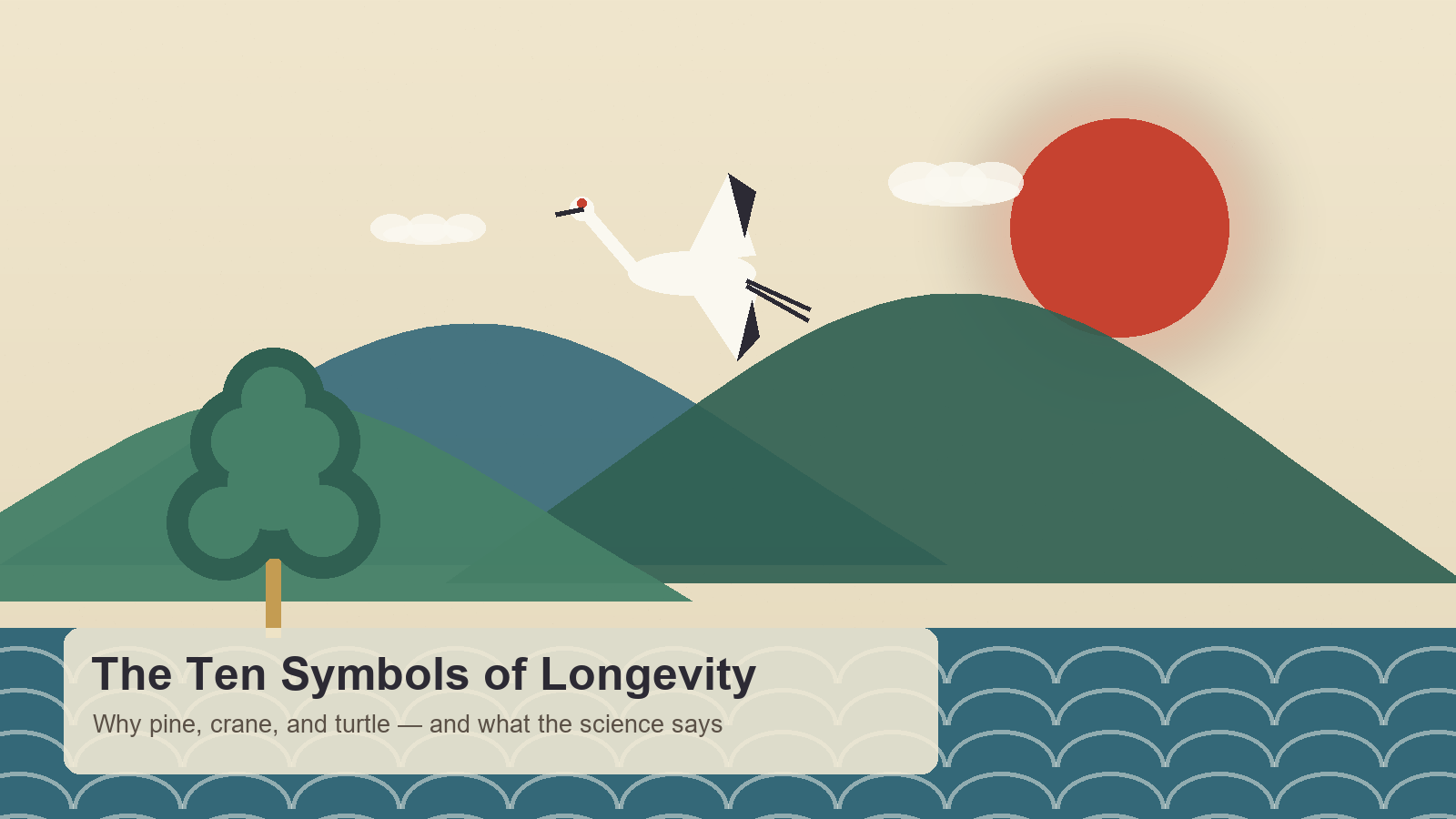
Picture an old painting. A red sun rising, ridge upon ridge of mountains, winding water, a standing rock, drifting clouds. Among them stands an evergreen pine; a crane spreads its wings; a turtle crawls at the water’s edge; a deer lifts its head. And somewhere in the scene sprouts a mysterious herb of eternal life. This is the Sipjangsaeng-do (十長生圖), the painting of ten longevity symbols that adorned the folding screens of Joseon-era homes and palaces.
Ten symbols of long life — sun, mountain, water, stone, cloud, pine, the herb of immortality, turtle, crane, and deer. Painted to carry a wish for longevity, it looks at a glance like beautiful decoration. But take the symbols apart one by one, and a surprising number of them overlap with where modern longevity science is pointing. Why did our ancestors choose these particular ten?
The Pine: Emblem of Evergreen Life — and “Healing Air”
At the center of the ten symbols sits the pine. An evergreen that never sheds its needles even in the harshest winter, it stands for a vitality that does not wither. Our ancestors knew from experience that stepping into a pine forest cleared the mind and refreshed the body — they just had no language for why.
Modern science is filling in that why. Pines and other trees release volatile compounds called phytoncides into the air. Originally these protect the tree from bacteria and pests, but they have intriguing effects on humans too. According to forest-bathing (森林浴) research published in 2026, exposure to phytoncides raises the activity of natural killer (NK) cells — which fight viruses and cancer — while lowering the stress hormone cortisol and tipping the body toward a relaxed, parasympathetic state. The evergreen tree of longevity was, quite literally, breathing out medicinal air.
Crane and Turtle: The Wisdom of Slowness
Two animals appear among the ten symbols: the elegantly winged crane and the slow-moving turtle. Both have long been bywords for long life — expressions like “the lifespan of a crane” or “living as long as a turtle” didn’t arise by accident.
What’s interesting is what these two share: unhurried, deliberate movement. The turtle in particular is one of the animal kingdom’s genuine longevity champions — some live well past 100 years. Science has an old hypothesis called the “rate of living theory,” the observation that animals with slower metabolisms and a gentler pace of life tend to live longer. It’s far from an absolute law and has many exceptions, but the intuition that living slowly relates to living long touches, remarkably, the very impulse that led our ancestors to project longevity onto the turtle and the crane.
Mountains, Water, and Nature Itself
The remaining symbols — mountain, water, rock, cloud — ultimately converge on one thing: nature that endures, unchanging and long-lasting, and a life lived close to it.
Here again, modern research sides with the ancestors. People who live closer to nature repeatedly show lower stress, better immune and cognitive function, and stronger overall health indicators. The restorative effects of forests, water, and mountains are now studied seriously under the name “nature therapy.” Hanging a painting of the ten symbols on the wall may, in a sense, have been an expression of the wish to keep nature close every day and to grow to resemble its rhythms.
Practicing the “Wisdom of the Ten Symbols” Today
Carry those 500-year-old screen symbols into today’s habits, and it looks like this.
- Into the forest once a week: Walk slowly through a pine grove or a tree-filled park. It doesn’t need to be a workout — simply lingering among trees lets you take in phytoncides and nature’s restorative effect.
- Learn the rhythm of slowness: Like the turtle and crane, build in deliberate moments to slow down during the day. An unhurried meal or one slow walk is enough.
- Keep nature close: If you can’t reach a forest daily, plant small contacts with nature into your routine — a pot by the window, a short park walk at lunch.
- Get your sunlight: Like the sun, the first of the ten symbols, a habit of catching even a little morning light genuinely helps your circadian rhythm and mood.
Frequently Asked Questions
What exactly are the ten symbols?
Commonly they are the sun, mountain, water, stone (rock), cloud, pine, the herb of immortality, turtle, crane, and deer. Depending on the text or painting, though, others like bamboo or peach sometimes appear, so the set varies slightly.
Do I have to go deep into a forest to get the phytoncide effect?
Concentrations are higher in deep mountains, but you can still benefit in a tree-rich urban park or garden. The key is spending unhurried time near trees.
Is the turtle’s long life really due to a slow metabolism?
Slow metabolism is cited as one factor, but longevity is a complex phenomenon tangled up with genes, cellular-protection mechanisms, and more. “Slowness” is one interesting clue, not the whole answer.
Does hanging a ten-symbols painting actually help your health?
The painting itself has no magical effect. That said, there is research that keeping nature-symbolizing images nearby aids psychological calm — and above all, the point is to practice what the symbols point to: living close to nature.
Closing Thought
The ten-symbols painting was never mere decoration translating a wish for long life into pictures. Folded within it were layered observations — the air of the evergreen tree, the wisdom of living slowly, a life lived beside nature. Our ancestors sketched the conditions of longevity in the language of symbols rather than the language of science, and now we are reading that picture back as data. Today, try looking at the single tree outside your window not as scenery, but as one of the oldest prescriptions there is.
The science hidden inside each symbol
The ten symbols of longevity (十長生) are usually read as art. But several map onto findings modern research would recognize.
- Pine (松): Evergreens anchor the practice of shinrin-yoku (forest bathing), shown to lower cortisol and blood pressure (Park et al., 2010). Time among trees is measurably restorative.
- Crane and Turtle (鶴・龜): Both are long-lived animals with slow metabolic rates — echoing the “rate-of-living” observation that slower, steadier physiology often accompanies longevity.
- Sun (日): Morning light exposure sets the circadian clock that governs sleep, metabolism, and hormone rhythms.
- Water and Mountain (水・山): Hydration and daily movement over varied terrain remain among the most robust predictors of healthy aging.
- Deer and the herb of eternal youth (鹿・不老草): A reminder that traditional pharmacopeia was an early, empirical search for compounds that support vitality.
Bringing the ten symbols into a modern day
- Get morning sunlight within an hour of waking (the Sun).
- Walk outdoors, ideally among trees (Pine, Mountain, Water).
- Eat and move at a steady, unhurried rhythm (Crane, Turtle).
- Protect sleep as the foundation of repair.
Frequently asked questions
Are the ten symbols just superstition? They began as symbolic art, but many encode habits — light, nature, steady rhythm — that hold up under modern scrutiny.
What are the ten? Commonly: sun, mountain, water, rock, cloud, pine, the herb of eternal youth, turtle, crane, and deer.