
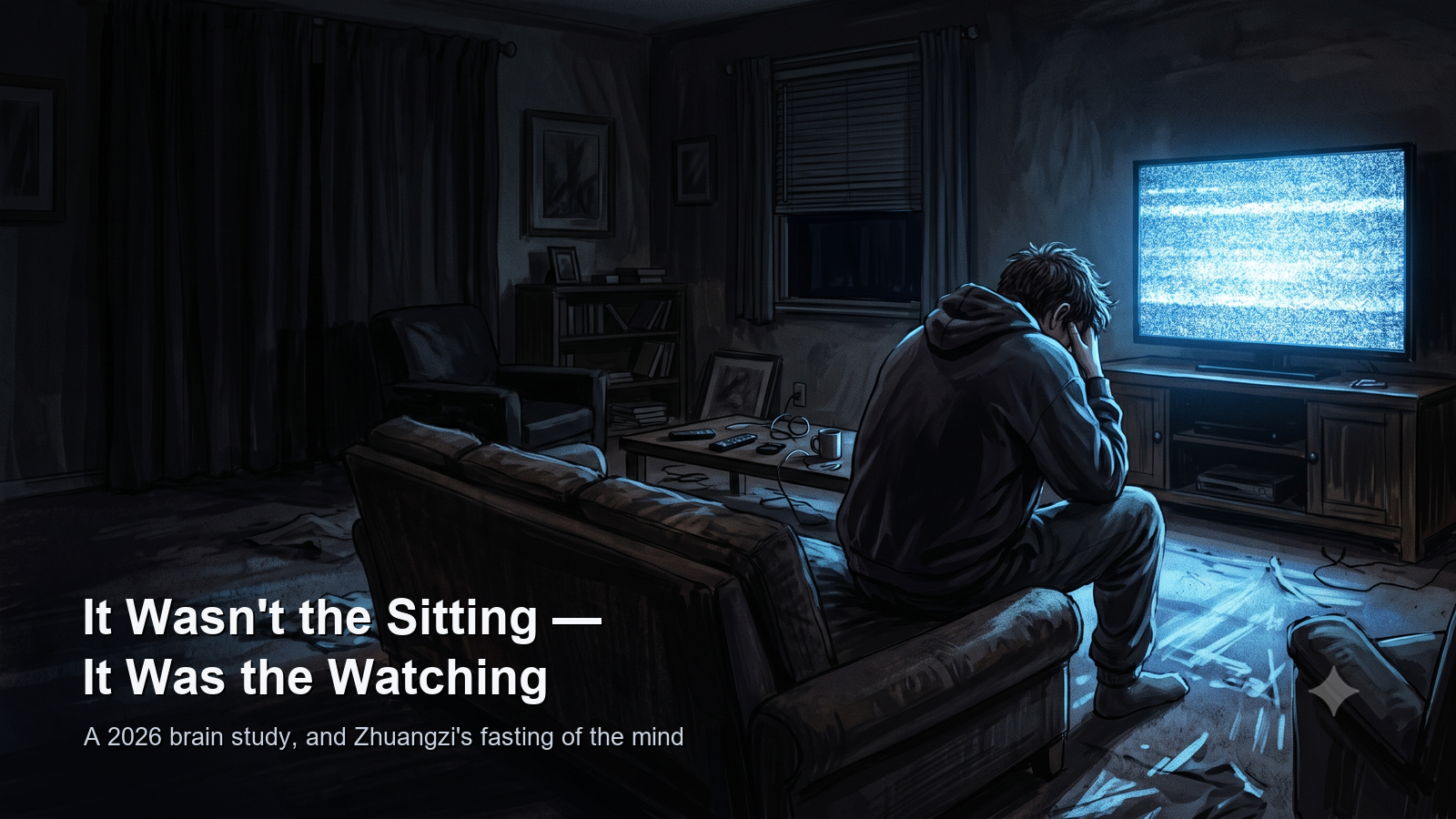
We’ve long been told not to sit too much — that sedentary time is the enemy of health. But a study published in 2026 put a strange crack in that assumption. The problem wasn’t the sitting itself. It was what you do while you sit.
Following 1,700 Brains Across Decades
Drawn from a large American cohort study (ARIC) and published in the journal Alzheimer’s & Dementia, the research surveyed the midlife TV-viewing habits of roughly 1,700 people, then imaged their brains with MRI decades later and compared them.
The findings were clear. People who reported watching TV “very often” in midlife later showed reduced volume in memory-related brain regions, smaller frontal and occipital lobes, and more damage in the brain’s white matter — the kind associated with aging, stroke risk, cognitive decline, and dementia. A single habit had, over decades, left its mark on the brain.
The Real Twist: It Wasn’t the Sitting
So far this reads as confirmation that sitting is bad for you. But the study’s real discovery comes next.
The researchers found that other forms of sedentary behavior did not carry the same associations. Remarkably, people who sat a great deal at work actually had larger frontal and occipital lobes and less white-matter damage — that is, better brain health.
Same posture, opposite outcome. The body was sitting in both cases, yet one group’s brains shrank and the other’s stayed healthy. Which means the variable was never the body. It was what the mind was doing while sitting — and that made all the difference.
In front of a television, the mind is passive. Information pours in one direction and nothing is asked of us. Sitting to work, by contrast, the mind is actively concentrating, judging, organizing. What the study suggests is this: it isn’t sitting that shrinks the brain. It’s a scattered mind.
What Zhuangzi Said 2,300 Years Ago
Here an old idea from Eastern philosophy lines up with uncanny precision.
The Zhuangzi tells of an old man catching cicadas. He plucks them from the air with a long pole as easily as picking them up by hand, and Confucius asks his secret. The old man answers: “用志不分, 乃凝於神” — when the will is not scattered, the spirit gathers into one.
Zhuangzi’s insight was never about rest versus motion. It was about a gathered mind versus a scattered one. The cicada-catcher’s body was still, but his attention was intensely concentrated. Conversely, however busy the body, if the mind is flung in all directions, that is precisely the state Zhuangzi warned against.
Television is, quite exactly, a machine for scattering attention — passive, fragmented, demanding no focus from us. Body seated, mind dispersed. And decades later, that state showed up as brain volume.
Xin Zhai: The Fasting of the Mind
The Zhuangzi offers an even deeper concept: xin zhai (心齋), “the fasting of the mind.” Just as there is a fasting that purifies the body, there is one that purifies the mind.
Xin zhai means emptying the noise and clutter within so that attention can gather wholly onto a single object. It sounds like “emptying,” but it is really an active concentration — clearing away the scattered so that one focus can form. If television is the machine that disperses the mind, xin zhai is the discipline, on the opposite side, that gathers it back.
Put in the language of modern neuroscience: the brain strengthens the circuits it uses often and prunes the ones it doesn’t. Active concentration repeatedly stimulates the circuits of attention, memory, and judgment; passive consumption lets them idle. The brain grows toward whatever we feed it. Zhuangzi arrived at that conclusion without neuroscience, framing it precisely as a question of where the mind is gathered.
Practicing the “Fasting of the Mind” Today
Bring the study and Zhuangzi together into daily life, and it looks like this.
- Don’t fear sitting — watch what you do while seated: Sitting to read, write, learn, and immerse is good for the brain. The problem isn’t posture; it’s the mind’s state.
- Cap your passive consumption: TV, short videos, endless scrolling are the classic “scattered mind” activities. You needn’t eliminate them, but manage the daily total deliberately.
- Immerse fully in one thing, once a day: A chapter of a book, an instrument, writing, a game of go — make any single-focus activity your time of xin zhai.
- Don’t mistake multitasking for focus: Doing many things at once scatters the mind. What Zhuangzi called gathered spirit (凝神) is the concentration of attention onto one.
Frequently Asked Questions
So should I never watch TV at all?
No. The study concerns habitual “very frequent” viewing in midlife. Occasional enjoyment is different from filling a large part of the day with passive watching. The point is total volume and balance.
Is sitting to work really better for the brain?
In this study, people who sat a lot at work showed better brain measures. This is read as the benefit of cognitively active sitting; the separate health risks of physical inactivity (metabolic, cardiovascular) still need attention on their own.
Is xin zhai the same as meditation?
There’s overlap, but not identity. Where meditation often centers on “emptying,” xin zhai leans toward using that emptying to gather the mind into one. It’s also close to the state of flow.
Do short-form videos carry the same problem as TV?
No study addressed them directly, but as fragmented, passive consumption they likely fall under “scattered mind.” The less focus a form of consumption demands, the more caution it warrants.
Closing Thought
We tend to think of health as a matter of posture or movement. But this study points somewhere unexpected: even in the same seated position, whether the mind is gathered or scattered can shape the brain decades later. Zhuangzi already saw the answer in the still, total concentration of an old man catching cicadas. This evening, before you reach for the remote, it might be worth asking: am I about to gather my mind, or scatter it?