
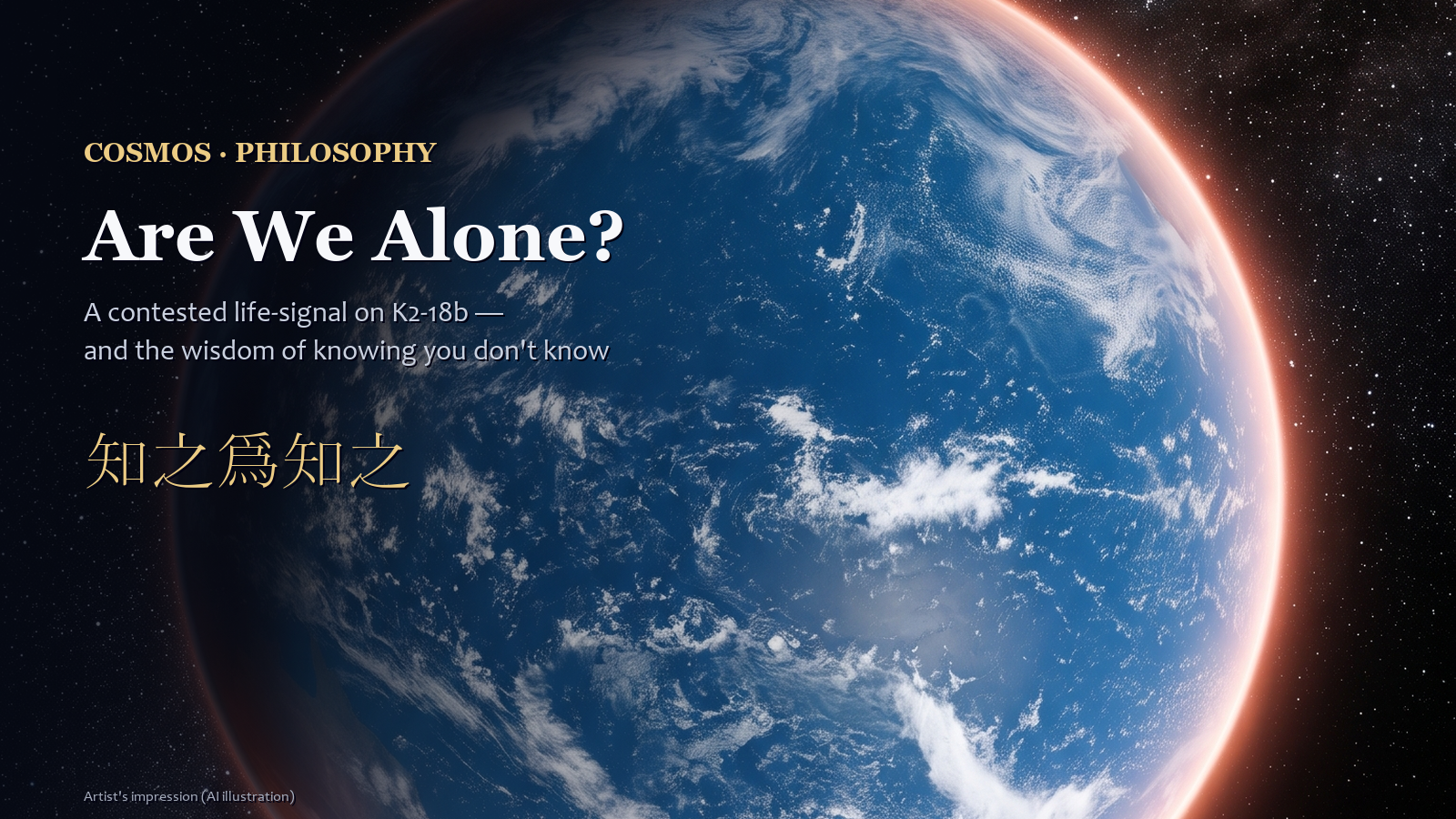
On a planet 124 light-years away, in its alien sky, scientists found a molecule that might be the scent of life.
In 2025, a team from Cambridge analyzing the atmosphere of the exoplanet K2-18b with the James Webb Space Telescope (JWST) reported something startling: a signal of dimethyl sulfide (DMS). On Earth, this molecule is produced almost exclusively by living things — marine plankton, above all. If the same molecule on that distant world was also made by life, it would be the first fingerprint of life humanity had ever caught beyond Earth.
The world lit up. “Are we alone?” — the oldest question we have asked since we first looked up — seemed on the verge of an answer.
And then — “We do not know yet”
What happened next is the real heart of this story.
The very scientists who announced the finding were extraordinarily cautious. “This is not a confirmation,” they repeated. “We are being careful.” Soon, research teams around the world began re-examining the same data. A NASA-led reanalysis and several other studies reached a sobering conclusion: the signal could be statistical noise, and it could be produced by abiotic processes that require no life at all. One 2025 paper put it bluntly in its title — “K2-18b Does Not Meet the Standards of Evidence for Life.”
This might sound like a disappointing anticlimax. I see the opposite. That conclusion — “we do not know yet” — is the most mature posture science can take. And, remarkably, it lands on exactly the same ground as an ancient Eastern wisdom.
知之爲知之, 不知爲不知 — To know that you do not know is knowledge
In the Analects, Confucius told his disciple Zilu:
“When you know a thing, to hold that you know it; and when you do not know a thing, to allow that you do not know it — this is knowledge (知之爲知之, 不知爲不知, 是知也).”
— Analects, Book II (Wei Zheng)
Written 2,500 years ago, that line describes the conduct of the K2-18b scientists with eerie precision. They did not rush to shout “We found life!” They said only what the data warranted, and admitted that what was uncertain was uncertain.
Our age treats “I don’t know” as a weakness, a defeat. Confident voices win the clicks; absolute claims gather the crowds. Confucius taught the reverse: to honestly know that you do not know — that is real wisdom. Premature certainty is not knowledge, but an imitation of it.
Perhaps the true lesson of K2-18b is not whether alien life exists, but that humanity is learning to stand before the cosmos and honestly say, “we do not know.”
井蛙不可以語於海 — You cannot speak of the ocean to a frog in a well
Go one step deeper. What, exactly, are we even searching for?
When we look for life, we look for Earth’s kind of life: water, carbon, oxygen, the chemistry we know. K2-18b drew attention precisely because it might hold a liquid ocean — a deeply earthly hope. Yet Zhuangzi saw the limit of this 2,300 years ago:
“You cannot speak of the ocean to a frog in a well — he is bound to his narrow space. You cannot speak of ice to a summer insect — it is confined to its season (井蛙不可以語於海者, 拘於虛也. 夏蟲不可以語於冰者, 篤於時也).”
— Zhuangzi, “Autumn Floods”
Before the ocean of the cosmos, perhaps we are the frog in the well. Do we imagine life only in the forms we already know, and search only for what fits that frame? Zhuangzi’s insight makes us humble: that we have not found something does not mean it is not there, and our way of knowing is not the only way. The size of the well is not the size of the world.
Re-seeing the question itself: “Are we alone?”
Here Eastern thought offers its deepest turn. The question “Are we alone?” rests on a hidden premise: that “I” and “the universe” are separate — that I am here, and life might be out there, somewhere apart. A lonely intuition.
But Zhuangzi says: “Heaven and earth were born together with me, and the ten thousand things and I are one (天地與我並生, 而萬物與我爲一).” From this view, you are not a solitary observer split off from the cosmos. You are already one of the eyes through which the universe looks at itself. The atoms of that planet 124 light-years away and the atoms of your body are siblings from the same stars.
In the deepest sense, then, we have never been alone. Whether or not K2-18b holds life, we are already woven into one vast cosmos with all things. The very yearning to find alien life may itself be a cosmic loneliness born of the illusion of separation.
So how should we meet this discovery?
This is not merely a distant astronomical dispute. K2-18b’s lesson in posture applies directly to daily life.
- Beware premature certainty. Not speaking of the uncertain as if it were certain — that is the “knowledge” Confucius meant.
- Do not be ashamed of “I don’t know.” Honest not-knowing is the beginning of learning, never a defeat.
- Doubt the size of your own well. Knowing that your frame is not the only frame is where humility begins.
- See loneliness anew. Within the sense that all things are one with you (天人合一), you were never alone to begin with.
Frequently asked questions
Has life actually been found on K2-18b? No. A possible signal of a life-indicating molecule (DMS) was reported, but subsequent reanalyses argued it may be statistical noise or explainable without any life. No extraterrestrial life has been confirmed to date.
Then is the discovery meaningless? Not at all. That humanity can now analyze and cross-check the faint chemistry of an exoplanet’s atmosphere is itself an enormous advance. The process and the caution are worth more than a premature conclusion.
What does Eastern philosophy have to do with modern astronomy? They meet not in the content of the discovery but in its posture. Honestly admitting what you do not know (知之爲知之), and knowing the limits of your own vantage (井蛙), are precisely the humility the best science demands.
Twenty-five centuries ago, Confucius said that true knowledge begins with knowing that you do not know. Now, before a planet 124 light-years away, humanity is learning that wisdom again. Perhaps the first lesson the universe means to teach us is not the existence of alien life, but an older truth: “You do not know yet — and to know that is where wisdom begins.”
Leave a Reply