
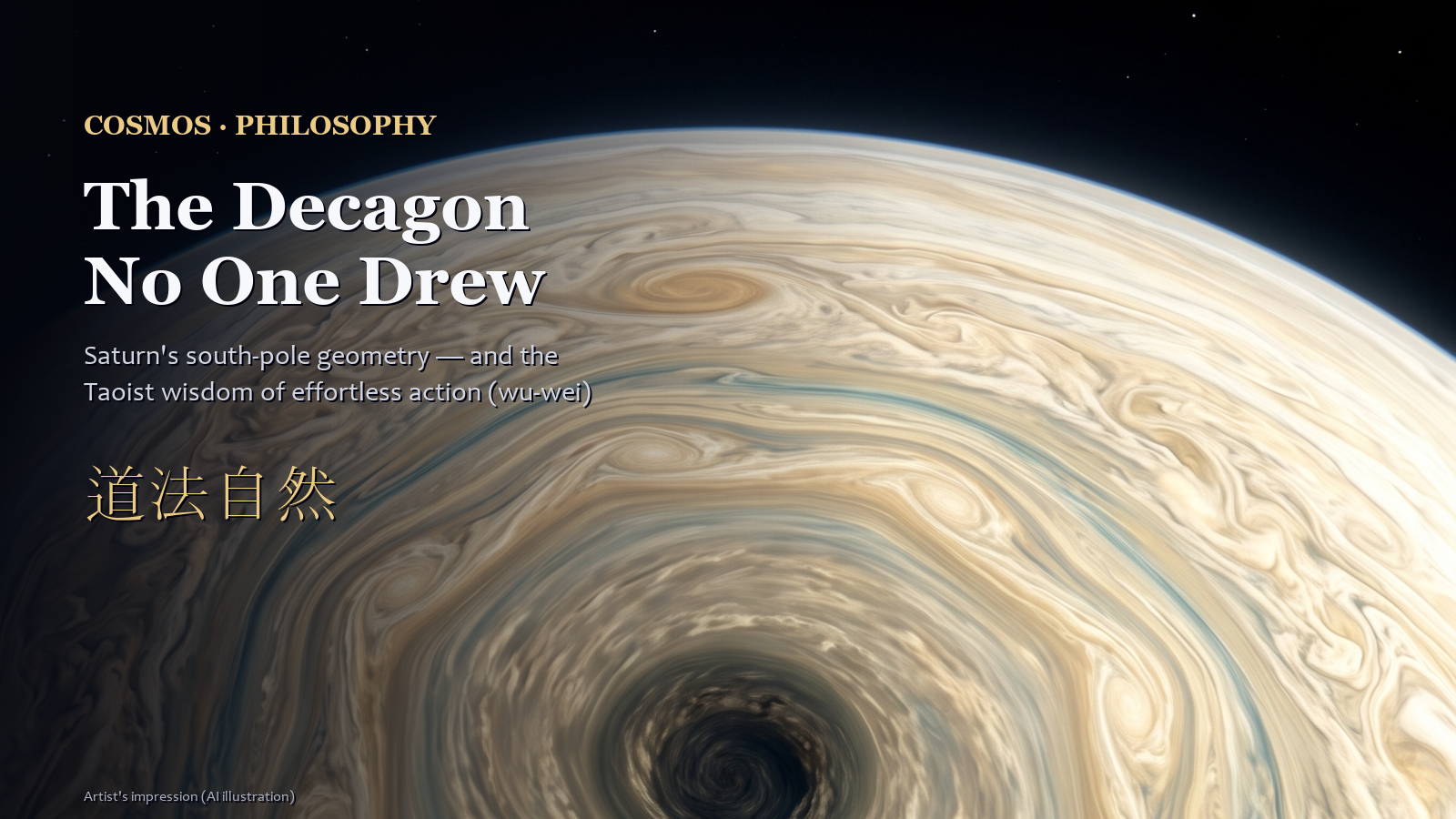
No ruler was ever laid against it. No compass ever turned. And yet, at Saturn’s south pole, there is a nearly perfect ten-sided figure — a decagon.
In September 2026, NASA’s Hubble Space Telescope announced it had confirmed a giant, ten-sided atmospheric wave encircling Saturn’s south pole. The planet’s north pole has famously worn a hexagon for nearly forty years — first spotted by the Voyager probes in 1987, a six-sided shape so vast that two Earths could fit inside it, yet astonishingly sharp-edged. Now, at the opposite pole, a figure with one more side than that: ten straight edges, drawn in cloud.
No wall, and no designer
The most astonishing thing is that this figure has no mold. No one built a wall; no one set a frame. This geometry is made by flowing gases alone, of themselves.
Here is how scientists explain it. Gas farther from the pole moves fast; gas nearer the pole moves slow. At the boundary where fast meets slow, the flow undulates and then settles into a stable standing wave — and seen from above, that wave reads as a polygon of six sides, or ten. Moreover, the pattern is not just a skin on the cloud tops: it is a vertically extended structure running through several atmospheric layers. Not a design carved in, but a form that the conditions of flow shaped by themselves.
To draw a single perfect decagon, a human needs a ruler and a protractor. Saturn drew one with no tools at all — simply by letting wind meet wind.
道法自然: The Way follows what is so of itself
Before this sight, I think of a line Laozi wrote 2,500 years ago.
“Humans follow the earth; the earth follows heaven; heaven follows the Way; and the Way follows what is so of itself (人法地, 地法天, 天法道, 道法自然).”
— Tao Te Ching, Ch. 25
Here ziran (自然) does not mean “nature” in our usual sense. Read literally, it is “self (自) so (然)” — that which becomes so of its own accord, with no one commanding or making it. Saturn’s decagon is a perfect picture of exactly this self-so-ness: with no blueprint, no order given, no maker, a flow arrives at order simply by following its own grain.
無爲而無不爲: Doing nothing, yet leaving nothing undone
Wuwei (無爲), the heart of Laozi’s thought, is often mistaken for “doing nothing at all.” But wuwei is not laziness; it is acting without forcing — not working against the flow.
“The Way does nothing, and yet there is nothing it does not do (道常無爲而無不爲).”
— Tao Te Ching, Ch. 37
Saturn’s atmosphere never strained to “draw a decagon.” There was no intention, no effort (wuwei). And yet the result is a figure larger and more beautiful than any precision drafting a human could manage (nothing left undone). Remove the forcing, and perfection is what remains. This is the paradox Laozi named: the greatest achievement comes from the place where effort is released.
天地有大美而不言: Heaven and earth hold a great beauty and do not speak of it
Zhuangzi adds a layer of silence.
“Heaven and earth hold a great beauty and do not speak of it; the four seasons hold a clear law and do not debate it (天地有大美而不言, 四時有明法而不議).”
— Zhuangzi, “Knowledge Wanders North”
Saturn has worn a hexagon at its north pole for over forty years and has never once boasted of it. Now it adds a decagon at the south, and says nothing. Laozi, too, wrote that “the greatest skill looks clumsy (大巧若拙).” Truly great making leaves no trace of effort, so that it looks as if it simply happened. Nature’s art is always finished this way — unsigned.
So what do we learn?
This does not end as a weather report from a distant planet. The logic of wuwei and ziran applies directly to how we live.
We so often force, trying to manufacture good outcomes. We try to control relationships, push our children, drive our organizations, squeeze out creativity. But as Saturn shows, real order comes not from control but from conditions. Set up the conditions of flow — let the fast gas and the slow gas meet — and beauty settles into place on its own. Just as a great leader sets the stage rather than dictating every move; just as a good parent prepares the soil rather than carving the child.
- Subtract the forcing. Instead of pushing what will not move, create the conditions in which flow can settle.
- Rhythm over control. Form appears where fast meets slow, tension meets release.
- Leave it unsigned. The best things are finished as if by themselves, with no “I did this” stamped on them.
- Trust silence. Heaven and earth complete a great beauty without a word. Anxious proving often ruins the work.
Frequently asked questions
Are Saturn’s polygons really there? Yes. The north-pole hexagon was found by Voyager in 1987 and has been stable for over forty years; in 2026 Hubble confirmed the south-pole decagon. These are real atmospheric structures.
Why a polygon shape? It is thought that where the fast jet farther from the pole meets slower gas near the pole, the flow forms a stable standing wave. The crests of that wave read as the six or ten straight sides.
Does 道法自然 just mean “return to nature”? No. “Self-so” (自然) is a principle, not a place — the way a flow reaches order without being forced. Saturn’s polygon is a literal example of it.
Saturn draws its decagon today with no ruler in hand. Laozi said: the Way follows what is so of itself. Perhaps the perfection we strain so hard to make is the very thing that arrives, on its own, the moment we stop forcing. Precisely because no one drew it, it was so perfect.
Leave a Reply