
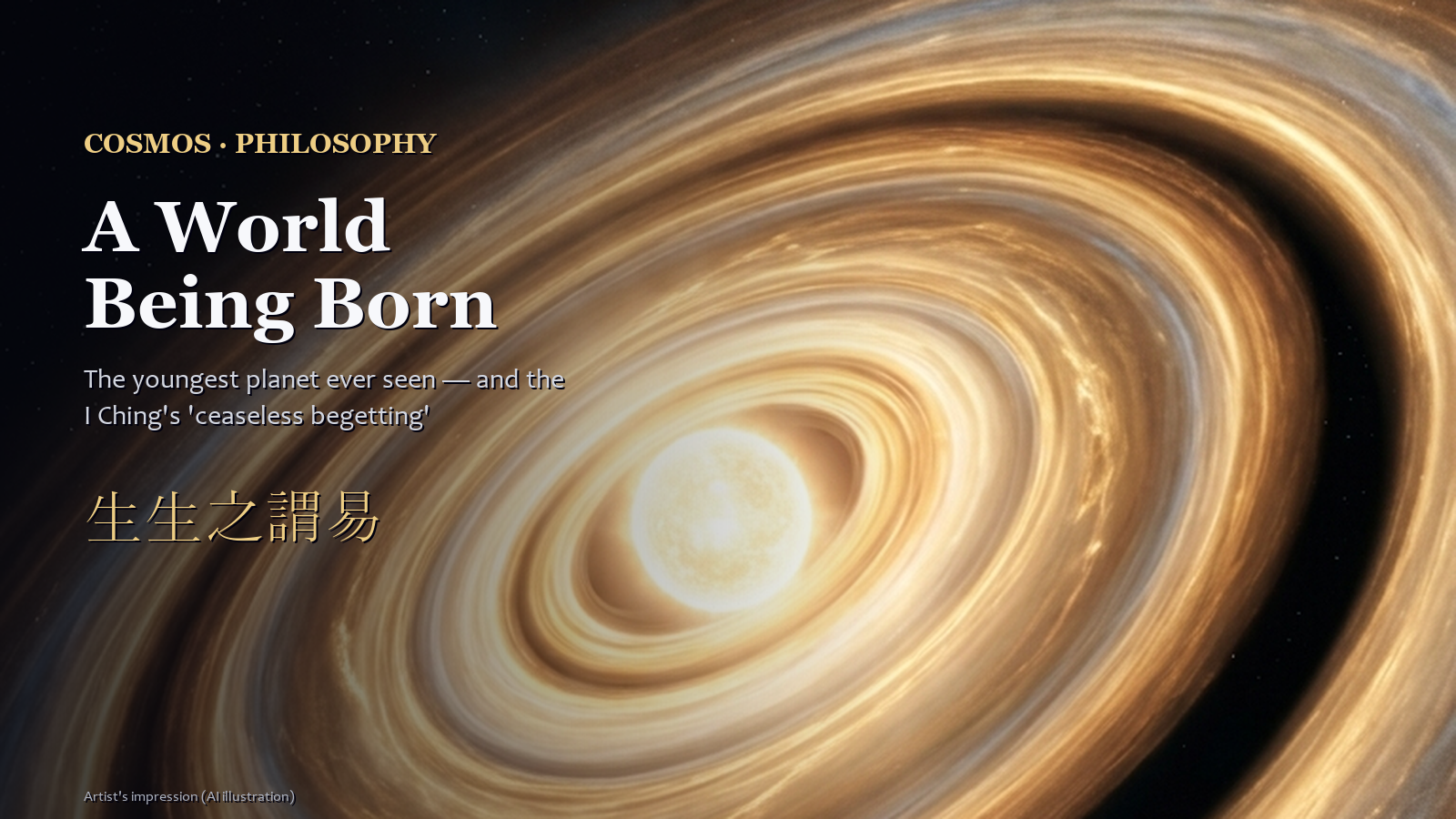
We tend to think of the universe as something finished. The stars are already up there; the planets were made long ago; creation was an event that ended 13.8 billion years ago with the Big Bang. And yet, in 2026, astronomers directly imaged a planet being born right now.
Its name is Elias 2-24 b — a Jupiter-sized world orbiting a newly formed star some 450 light-years away. The astonishing part is its age: less than one million years old. On the cosmic clock, a million years is as brief as a newborn’s first breath. It is the youngest exoplanet humanity has ever confirmed — literally a baby planet.
A planet still growing
What makes Elias 2-24 b remarkable is not only its youth, but that it is not yet finished. Around a newborn star spins a vast disk of gas and dust — a “protoplanetary disk.” A new planet grows by pulling in the material of that disk.
Astronomers found a single gap carved into this disk. Like a groove in a vinyl record, that empty furrow was the trace of a young planet devouring the matter along its orbit. By combining the W. M. Keck Observatory, ALMA, and the European Southern Observatory’s Very Large Telescope, humanity finally captured, inside that gap, a planet in the very act of being born. Even now, Elias 2-24 b is swallowing the disk and slowly becoming a larger world.
What we have seen is not a finished result, but creation in progress.
天地之大德曰生: The great virtue of heaven and earth is to give life
Before this scene, I think of a line from the Book of Changes (I Ching), written some 3,000 years ago.
“The greatest virtue of heaven and earth is to give life (天地之大德曰生).”
— Book of Changes, Great Commentary
In the Eastern view of the cosmos, the essence of heaven and earth — of the universe itself — is not a static, finished object but the very power that ceaselessly gives birth to things. The most fundamental character of the cosmos is not destruction, nor stillness, but sheng (生) — begetting. Elias 2-24 b proves this ancient intuition before our eyes. The universe is not a finished museum that has stopped; it is a living womb, still giving birth to new worlds.
生生之謂易: Ceaseless begetting is what we call Change
The Book of Changes goes one step further.
“Begetting and begetting again — this is what we call Change (生生之謂易).”
— Book of Changes, Great Commentary
Yi (易) means change. Yet the classic defines the essence of change not as disappearance but as sheng-sheng (生生) — begetting and begetting again. One thing is born, it gives rise to another, and the current flows on forever. When a star dies, its material births new stars and planets; and on such a planet, one day, life itself may be born. The birth of Elias 2-24 b is one scene, luckily witnessed, in this vast chain of ceaseless begetting.
有生於無: Being arises from non-being
So what was this planet born from? From a disk of gas and dust that looked all but empty — from very nearly nothing, a solid world condensed into being. Laozi compressed this principle:
“The ten thousand things are born of being, and being is born of non-being (天下萬物生於有, 有生於無).”
— Tao Te Ching, Ch. 40
Formless dust (something close to nothing) gathers into a planet with form (being). Creation begins not in the crowded places but in what looks empty. Just as Elias 2-24 b was born by opening a gap in the disk, the new always makes itself by opening empty space. Emptiness is not lack; it is the condition of creation.
So what does this say about our lives?
Here is why this is not merely distant astronomy. Seeing the universe not as finished but as still being born changes how we see ourselves.
We often treat ourselves as already-hardened finished products: “This is just who I am.” “It’s too late now.” “It’s all decided.” But if the cosmos is still shaping a million-year-old baby planet, then you, too, are not a completed statue but a world still forming. Each day is not a repetition of the old but sheng-sheng — a chance to be born anew.
- Do not declare yourself “finished.” You are still gathering material from your own disk.
- Do not fear emptiness. Gaps and blank space are not lack, but room for the new to enter.
- See change as begetting, not vanishing. Through the eyes of sheng-sheng, every ending is material for the next beginning.
- Meet each day as a birth. As the cosmos never stops giving birth, you too can begin again today.
Frequently asked questions
How young is Elias 2-24 b? Less than one million years old — the youngest exoplanet ever confirmed. Against the universe’s age of 13.8 billion years, it is a newborn.
What does “still being born” mean? The planet is still pulling in material from the gas-and-dust disk around its star, growing in size. It is a world whose formation is not yet complete.
Does the I Ching’s sheng-sheng really align with modern astronomy? They meet in worldview and posture. The Eastern intuition that the cosmos is not a stopped, finished object but an endless process of begetting is shown, before our eyes, by the direct image of a planet still forming.
Three thousand years ago, the Book of Changes said the greatest virtue of heaven and earth is to give life. Now humanity watches a million-year-old baby planet being shaped inside its disk. The universe is not finished and still. The universe is, even now, ceaselessly giving birth to new worlds — and you, too, are still being born.
Leave a Reply