
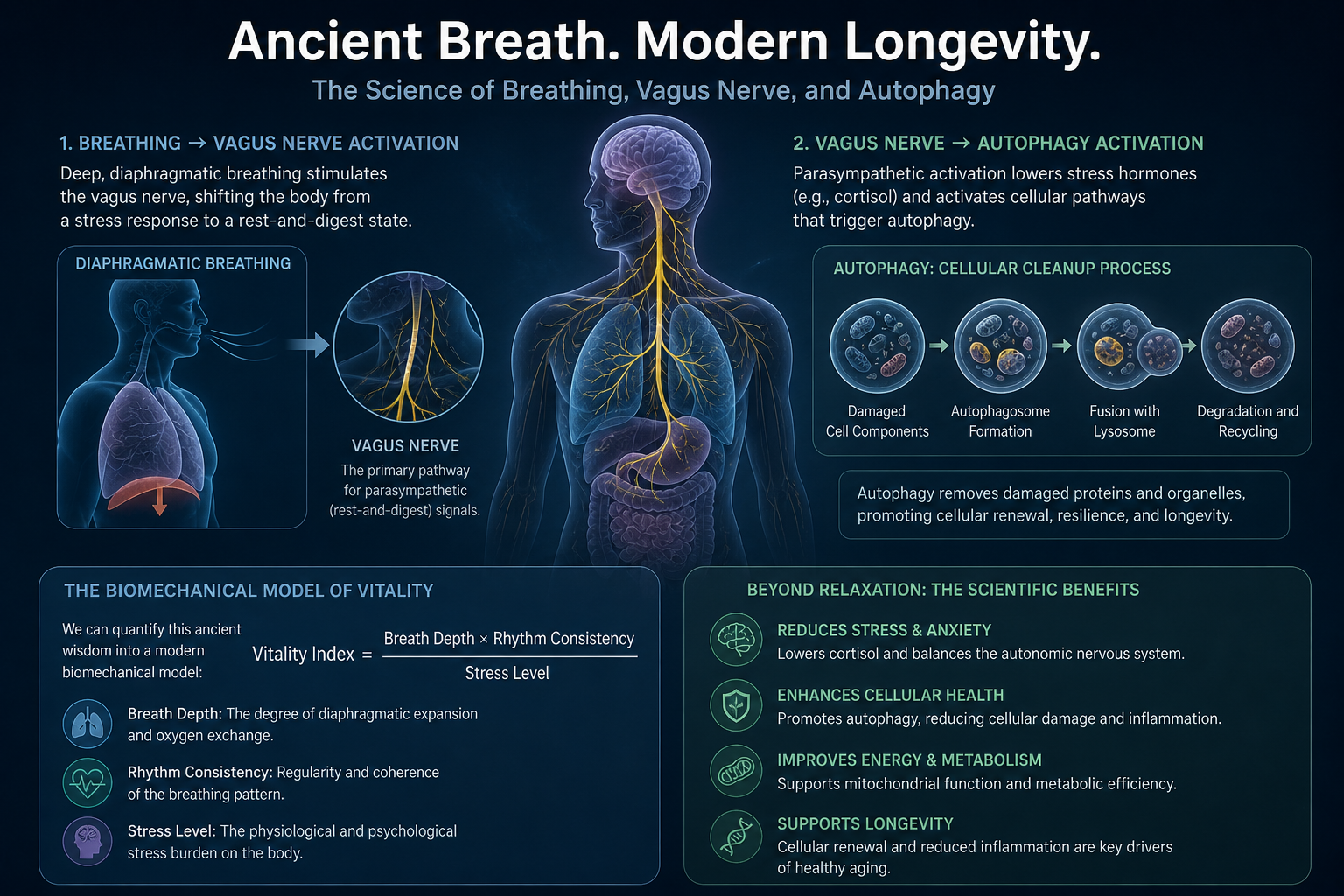
The modern longevity industry spends enormous sums studying autophagy — the body’s process of clearing out damaged cellular components and recycling them into something usable. It is one of the most exciting areas in aging research. And it has become fashionable to claim that you can switch it on with the right breathing technique.
A line from the Tao Te Ching, written some 2,500 years ago, is often cited as the ancient version of that idea. It’s worth reading carefully — because what it actually prescribes is both simpler and more interesting than the marketing version.
虛心實腹: Empty the Mind, Fill the Abdomen
虛心實腹 — Empty the mind, fill the abdomen. Tao Te Ching, Chapter 3
In its original context, this line is about governance and desire: a sage-like order keeps people free of grasping ambition (an “empty” mind) and materially satisfied (a “full” belly). But in the later tradition of nourishing life (養生), it was read as a bodily instruction as well, and it became one of the most quoted phrases in Chinese breathing practice.
Read that way, the line describes something quite precise. “Emptying the mind” is the quieting of mental agitation. “Filling the abdomen” is drawing the breath low, into the belly, rather than letting it sit shallow and high in the chest. Anyone who has watched a sleeping infant breathe has seen what that looks like: the belly rises and falls, the shoulders stay still.
What Deep Abdominal Breathing Actually Does
Here the physiology is well established. Breathing low into the abdomen engages the diaphragm fully. Slow breathing — and especially a long exhale — stimulates pressure receptors in the lungs and cardiovascular system, which raises activity in the vagus nerve, the main pathway of the parasympathetic “rest and digest” state.
The measurable consequences are real: heart rate slows, heart rate variability rises, and subjective stress falls. A Stanford study published in Cell Reports Medicine found that five minutes a day of exhale-focused breathing improved mood and lowered resting respiratory rate more than mindfulness meditation over the same period. We covered that research in detail in the piece on five-minute breathing.
But Does It Trigger Autophagy? An Honest Answer
This is where the popular version overreaches, and it’s worth being precise, because precision is what separates a useful practice from a wellness slogan.
Autophagy is primarily governed by nutrient sensing. When energy is abundant, the mTOR pathway is active and autophagy is suppressed. When energy runs low — during fasting, caloric restriction, or sustained exercise — AMPK activity rises, mTOR quiets down, and autophagy increases. This is the mechanism Yoshinori Ohsumi’s work opened up, which won the 2016 Nobel Prize in Physiology or Medicine.
Breathing is not a recognized primary trigger of that pathway. There is no good evidence that a breathing session switches on autophagy the way a prolonged fast does. Anyone who tells you otherwise is selling something.
What breathwork does do is shift the body into the parasympathetic state associated with recovery and repair, and reduce chronic stress signalling — and chronically elevated stress hormones are themselves unhelpful for cellular maintenance. So breathwork supports the conditions in which the body repairs. It is a genuine benefit. It is simply a different claim from “it triggers autophagy.”
Why the Old Text Still Gets It Right
Notice that the classical instruction is a pair, not a single move: empty the mind and fill the abdomen. The tradition never treated breathing as a standalone hack. It sat alongside moderate eating — eating sparingly, stopping before fullness, the long habit of restraint that runs through Eastern nourishing-life practice.
And that pairing is, in modern terms, exactly right. Eating with restraint is what engages the nutrient-sensing pathways that drive autophagy; breathing well is what calms the nervous system that governs recovery. The ancients bundled the two because they observed that both were needed. We covered the eating half of that equation in the piece on intermittent fasting and the Buddhist monastic rule.
The old formula wasn’t a shortcut. It was a description of a life with two working halves.
How to Practice It
- Find the abdomen: Rest a hand just below the navel. Inhale so that hand rises; keep the shoulders still. This is “filling the abdomen.”
- Lengthen the exhale: Aim for an out-breath roughly twice as long as the in-breath — four seconds in, eight out is a reasonable target. Comfort matters more than the numbers.
- Five minutes daily: That’s the duration used in the research, and it’s short enough to actually keep doing.
- Pair it with restraint at the table: If autophagy is the goal, the lever is how and when you eat, not how you breathe. Stopping before you’re full does more than any breathing pattern.
- Don’t force it: Straining for maximum depth can cause dizziness. Slow and unforced beats deep and effortful.
Frequently Asked Questions
Can breathing alone induce autophagy?
There’s no solid evidence that it can. Autophagy is driven mainly by nutrient availability — fasting, caloric restriction, and exercise are the established levers. Breathwork’s benefits lie in stress regulation and parasympathetic recovery.
So is breathwork overrated?
No — it’s simply often mis-marketed. Lower stress, better heart rate variability, easier sleep, and improved mood are all worthwhile and reasonably well supported. Those are the honest claims.
What does 虛心實腹 mean in its original context?
In Chapter 3 of the Tao Te Ching it describes an approach to governing: keep people free of grasping desire and materially content. The later nourishing-life tradition also read it as guidance for the body and breath.
How long before I notice anything?
The calming effect of a long exhale is often felt within a few breaths. Changes in baseline stress and sleep tend to show up over weeks of consistent practice.
Closing Thought
There’s a temptation to translate every ancient line into a biological switch — to make 虛心實腹 into a button that turns on autophagy. The text deserves better, and so does the reader. What it actually offers is steadier and more useful: quiet the mind, breathe low, eat with restraint. One of those calms the nervous system, another drives cellular housekeeping, and together they describe a way of living rather than a trick. Two and a half thousand years on, that’s still the honest version of the advice.