
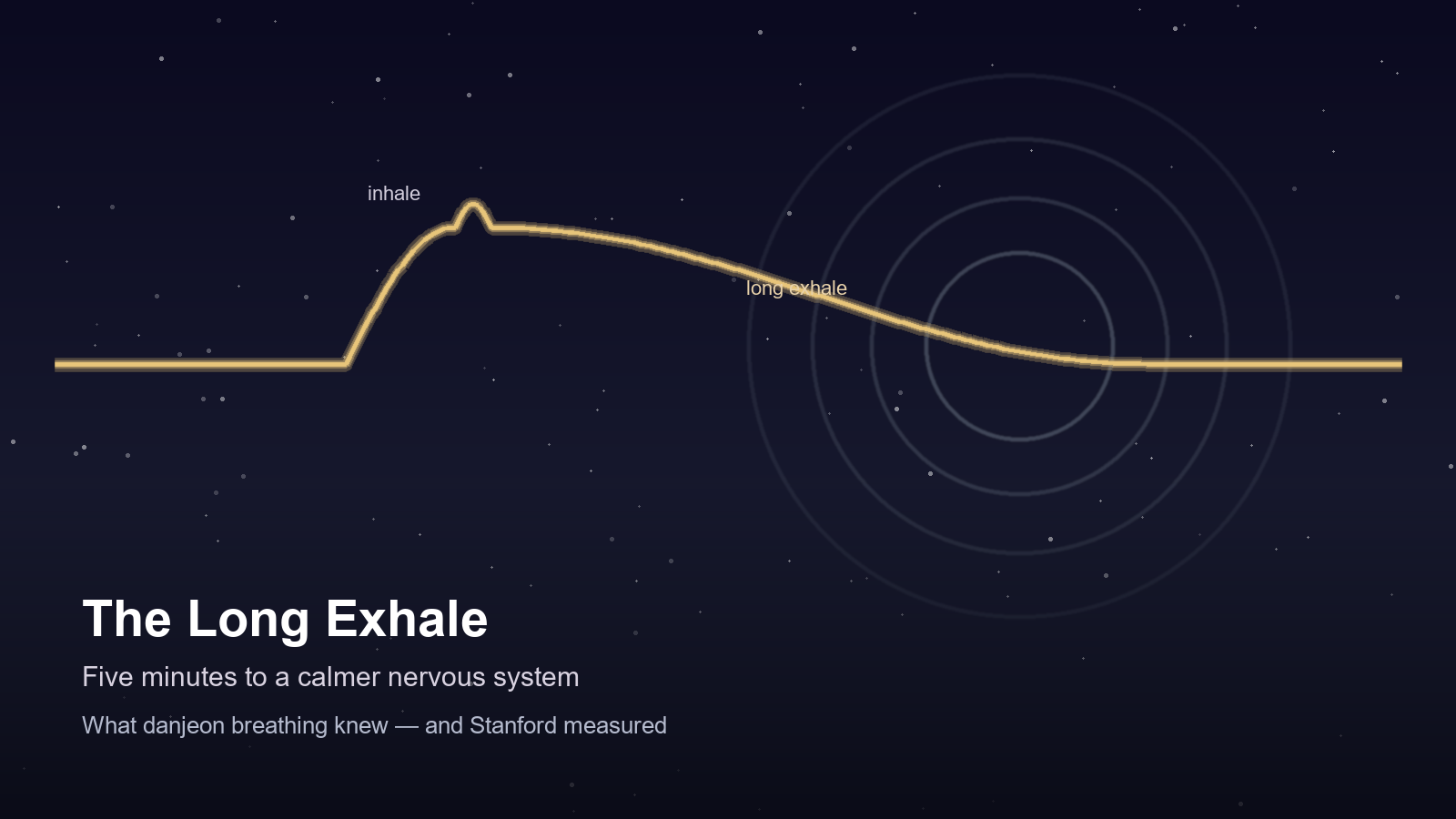
Right where you’re sitting as you read this, try one thing. Breathe in through your nose, then exhale very slowly through your mouth — about twice as long as the inhale, all the way to the end. Do it just three times.
How does that feel? Notice the shoulders drop a little, the mind settle a notch? You just changed the gear of your own nervous system, by hand. This simple move has been at the heart of Eastern practice for thousands of years — and a Stanford study has now measured exactly how well it works.
Danjeon Breathing: the East’s Refined Art of the Long Exhale
Across many Eastern traditions runs a shared discipline of regulating the breath. Danjeon breathing (丹田呼吸), from Korean and Taoist tradition, is a prime example: you draw the breath slowly and deeply down toward the danjeon, below the navel, and let it out in a long, unhurried exhale. The same principle flows through qigong, through Buddhist seated meditation, and through yoga’s pranayama.
These traditions speak in different languages, but they all emphasize one thing: lengthen the out-breath. Not quick, shallow panting, but slow and deep, with the exhale especially drawn out. The old practitioners knew from experience that this long exhale quiets the mind. They simply had no vocabulary for what, precisely, it was doing inside the body.
What Stanford Measured About “5-Minute Breathing”
In 2023, researchers at Stanford put this ancient intuition on the lab bench. Published in the journal Cell Reports Medicine, the study had participants practice a specific breathing technique for just five minutes a day over the course of a month.
The most effective of the methods tested was “cyclic sighing” — breathing that emphasizes a long exhale. You inhale once through the nose, take a second short inhale on top, then release a very long exhale through the mouth. Strikingly, the group practicing this 5-minute breathing saw greater improvements in mood, and larger drops in their resting breathing rate, than the group doing mindfulness meditation. This doesn’t mean breathing beats meditation across the board — only that for releasing the body’s tension in a short window, the long exhale is especially powerful.
Why a Long Exhale Settles the Body
The key is the vagus nerve. The vagus is the longest cranial nerve, running from the brain down to the heart and gut, and it governs the body’s “rest and digest” parasympathetic state.
When you exhale for a long time, pressure receptors (baroreceptors) in the lungs and cardiovascular system are stimulated, and this raises the activity of the vagus nerve. As the vagus becomes more active, the heart rate slows and the body shifts from tension mode (sympathetic) into relaxation mode (parasympathetic). In other words, the long exhale isn’t just a matter of mood — it’s a physical operation that changes the gear of your autonomic nervous system. Objective measures like heart rate variability (HRV) confirm that parasympathetic activity rises during slow, deep breathing.
When danjeon breathing taught people to send the breath deep and let it out long, it was, in effect, pressing this vagus-nerve switch by hand, every day.
A 5-Minute Breathing Routine You Can Start Today
No equipment, no special place. You can do it sitting or lying down, right now.
- The basic long exhale (5 minutes a day): Inhale comfortably through the nose, exhale through the mouth for twice as long. For instance, in for 4 seconds, out for 8. Rather than fixating on the numbers, what matters is the felt sense that the exhale is clearly longer than the inhale.
- The cyclic sigh (when tension spikes): Inhale through the nose, and when the lungs feel full, take one more short inhale on top, then release a very long exhale through the mouth. Even 1–3 rounds produce an immediate calming effect.
- Add the danjeon sense: Rest one hand below your navel, and let that spot rise on the inhale and fall on the exhale. Learn the feel of breathing into the lower belly, not the chest.
- Good timing: Before sleep (to ease into rest), right before something stressful (a talk, a meeting), or in the morning to begin the day. Any 5 minutes will do.
Don’t force the breath so deep that you get dizzy — stay within a comfortable range and go slow. The point isn’t intensity, it’s the slow, long exhale.
Frequently Asked Questions
Do I have to complete the full 5 minutes for it to work?
Five minutes is the duration validated in the research, but even a few long exhales when you’re tense produce an immediate calming effect. Doing a little every day, consistently, is what matters most.
Is danjeon breathing different from just deep breathing?
In broad terms it’s the same principle (slow, deep breathing). Danjeon breathing specifically focuses on sending the breath deep into the lower belly and exhaling long — think of it as a systematized form of abdominal breathing.
Why does a longer exhale calm you down?
Because the long exhale stimulates the vagus nerve and activates the parasympathetic (relaxation) system. The inhale, by contrast, relatively stimulates the sympathetic (arousal) side — so if calm is the goal, lengthening the exhale is the lever to pull.
Is breathwork better than meditation?
It’s not that simple. Both work; the Stanford study just found breathwork especially prominent for improving mood and easing tension over a short period. Meditation and breathing complement each other when practiced together.
Closing Thought
The fastest, cheapest calming tool there is — usable anytime, anywhere — is already built into your body. All it takes is your nose, your mouth, and one long exhale. The practitioners gathering breath at the danjeon thousands of years ago and the Stanford scientists measuring respiration rates in a lab walked different roads to arrive at the same place. Today, when tension rolls in, try reaching for one long breath instead of your phone. Those five minutes may change more than you’d expect.