
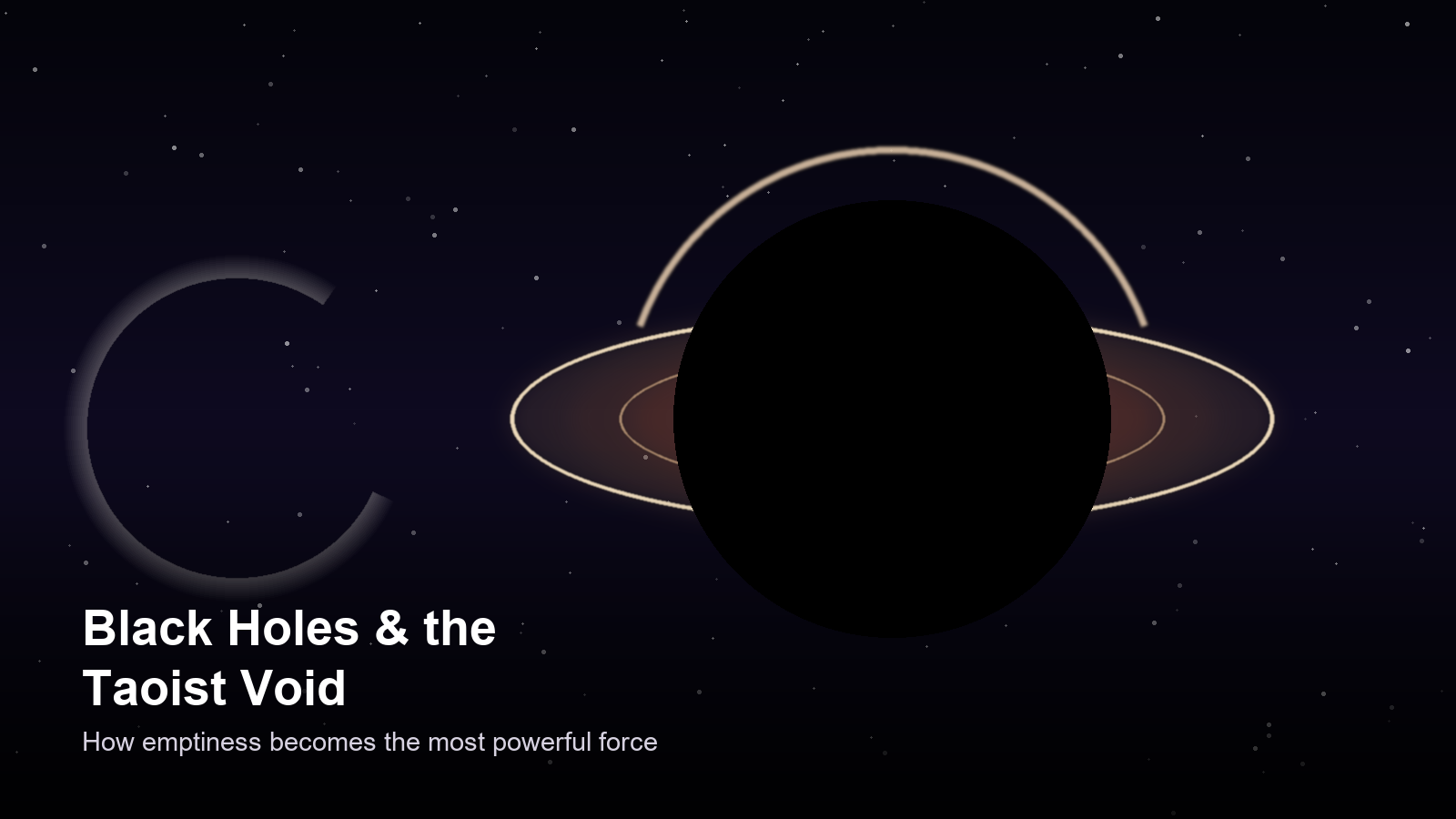
Astronomers with the LIGO-Virgo-KAGRA gravitational-wave network recently released the largest catalog of black hole collisions ever assembled — 390 confirmed merger events. Buried inside that data were signals that may finally offer a real lead on primordial black holes, an idea that’s existed purely as theory until now, and the news sent a ripple through the astronomy world.
Reading about it, one thing struck me as strange all over again. If you had to name the single most powerful object in the universe, a black hole would be the obvious answer. And yet at its center — the singularity — there’s almost nothing left that we’d normally call “matter.” The fact that something close to nothing generates a pull so strong that even light can’t escape it feels stranger the more you sit with it.
That’s when a line from the Tao Te Ching comes to mind: a clay pot is shaped from clay, but what actually makes the pot useful is the empty space inside it. Laozi obviously had no idea about astrophysics 2,500 years ago, but the core idea — that emptiness itself is the source of power, not the absence of it — lines up in a strange way.
What Laozi Meant by “Useful Emptiness”
Chapter 11 of the Tao Te Ching has a well-known passage: thirty spokes converge on a single hub, and it’s the emptiness at the center of that hub that makes the wheel useful. The same goes for a clay vessel, and the same goes for a room. Walls and a door make something a room, but what actually makes it livable is the empty space they enclose, not the walls themselves.
Laozi doesn’t stop there. In Chapter 5, he compares the space between heaven and earth to a bellows — empty, yet never exhausted; the more it moves, the more it produces. That’s not just a poetic flourish. It’s a stance that runs through the entire philosophy: that absence carries more fundamental power than presence, that emptying out matters more than filling up.
Honestly, the first time I read that line, I took it as a nice piece of poetry and nothing more. Learning about black holes made me look at it differently.
Black Holes: The Overwhelming Power of Something That Looks Like Nothing
The singularity at the center of a black hole is a genuinely strange point in physics. Mass is definitely there, but volume theoretically converges to zero — meaning density diverges toward infinity. It’s the opposite of what we’d picture as “matter packed tight.” At the singularity, our normal concept of matter itself basically breaks down.
And yet the gravity coming out of that point is the strongest force in the universe, strong enough to create an event horizon that not even light can cross. It’s not powerful because something is “full.” It’s powerful precisely because it’s in an extremely condensed, emptied-out state — and that state produces more force than anything else we know of.
The more interesting piece is what quantum mechanics calls the “vacuum.” A space that looks completely empty is actually a place where particle-antiparticle pairs are constantly popping in and out of existence through quantum fluctuation. Hawking radiation, the phenomenon Stephen Hawking predicted, is explained as this same fluctuation happening right at a black hole’s event horizon. In other words, “empty space” turns out to be one of the most dynamic stages in the entire universe.
Why These Two Ideas Sound Like the Same Story
To be clear, I’m not claiming Taoist philosophers somehow predicted quantum mechanics. That kind of leap tends to slide into pseudoscience fast, and it’s not a move I’m interested in making.
What I do want to point out is that two completely different eras, using completely different languages, landed on the same conclusion: emptiness isn’t a lack, it’s potential. For Laozi, emptiness was the condition that made a vessel, a room, or a wheel useful. In modern physics, the vacuum is an ocean of energy where particles are constantly being generated. Both treat “empty” not as a deficiency but as a state loaded with possibility, and that overlap is worth sitting with.
Practicing “Xu” (虛) in Daily Life
Bringing this down to earth is simpler than it sounds. Most people already know from experience that a day packed wall-to-wall with plans tends to produce worse ideas and less resilience than a day with some intentional empty space built into it.
- Leave a gap in your schedule: Block off at least 30 minutes a day with absolutely nothing planned. That “useless-looking” time often turns out to be the most useful part of the day.
- Notice the pause between breaths: Bring your attention to that brief stillness between inhale and exhale. In Taoist breathing practice, that short pause is considered the most important part of the cycle, not a gap to rush through.
- Clear out one object: Remove one unused item from your desk or room. The more space you clear, the more obvious what that space is actually for.
This isn’t a call to go full minimalist. It’s just a nudge to leave one small margin of nothing in your day.
Frequently Asked Questions
Is the Taoist concept of “Xu” (虛) the same as just “nothingness” (Wu, 無)?
They’re related but not identical. Wu points to the absence of existence itself, while Xu leans closer to a functional kind of emptiness — an emptiness that generates usefulness.
Does a black hole’s singularity actually mean it’s “empty”?
Not exactly. It’s a mathematical point where volume converges to zero and density diverges toward infinity. It’s less that it’s “empty” and more that our normal concepts of matter and space stop applying there. This piece uses it metaphorically, as the opposite of “packed full.”
Has it actually been proven that quantum vacuum isn’t truly empty?
Yes — phenomena like the Casimir effect provide experimental support for the existence of vacuum energy. The vacuum isn’t a space where nothing happens; it’s a space where quantum fluctuation never stops.
Is comparing ancient Eastern philosophy to modern physics like this taken seriously academically?
It’s better understood as a philosophical or metaphorical comparison rather than a scientific proof. But the fact that two very different eras of thought arrived at a similar intuition is, at minimum, an interesting thought experiment.
Closing Thought
The idea that the most powerful thing might not be the fullest thing, but the emptiest one, is something Laozi pointed at 2,500 years ago and physicists are pointing at today, each in their own language. Setting aside the habit of trying to fill every gap, and leaving some intentional empty space somewhere in today, doesn’t sound like a bad idea.