
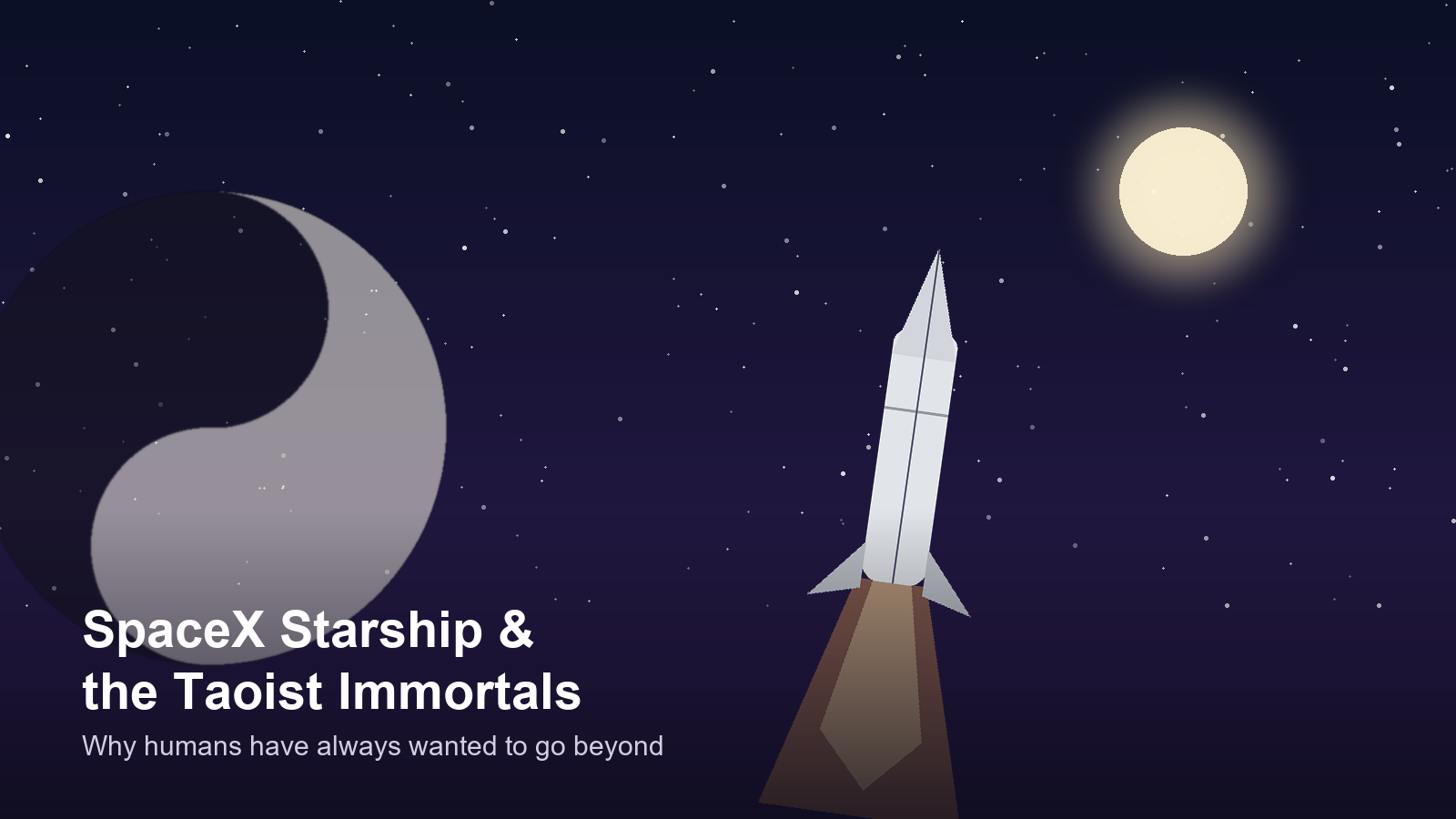
I was watching a Starship launch livestream last week when a strange thought hit me. All that money, all that time, all that risk humanity keeps pouring into pushing a giant chunk of metal into orbit — why? “Because we need to get to Mars” never felt like a complete answer. So I went looking for something more fundamental. Why do humans keep trying so hard to leave the place they’re already in?
Part of the answer isn’t in rocket engineering at all. It’s sitting in a body of Taoist thought that’s over two thousand years old: the philosophy of the xian, or immortals (神仙思想). The desire to “transcend the limits of this body and become something beyond it” looks like the same instinct running through human history, from the First Emperor of Qin all the way to Elon Musk’s Mars plans — just wearing different clothes each time.
The People Who Chased Immortality: Qin Shi Huang and the Xu Fu Expedition
In 219 BCE, Qin Shi Huang, the emperor who unified China, gave an order to a court alchemist named Xu Fu. He was to sail past the eastern sea to the Three Sacred Mountains — Penglai, Fangzhang, and Yingzhou — and bring back the elixir of immortality. Xu Fu set out with thousands of young men and women and a massive fleet. He never came back.
The part of this story I find most interesting, honestly, is that it never ends. Nobody knows if Xu Fu actually landed somewhere, or if the fleet simply vanished at sea. But that unresolved “we don’t know” is exactly what keeps the story alive. Humans tend to move harder toward possibilities that were never confirmed either way.
In Taoism, a xian isn’t just someone who lives a long time — it’s a being freed from the physical constraints of the body: gravity, aging, the limits of space itself. When texts describe immortals “riding on clouds” or undergoing yuhuadengxian (羽化登仙, “sprouting feathers and ascending”), it reads less like fantasy and more like an early attempt to draw a picture of the same longing: the wish to step outside the laws of physics that bind us.
Kunlun Mountain and the Coordinates of “Beyond”
In Chinese mythology, the immortals are said to live on Mount Kunlun, somewhere at the far western edge of the world — a place humans could never actually reach. It’s where the Queen Mother of the West, Xiwangmu, resides: a location with no coordinates on any map, an ideal precisely because it stayed unreachable.
What’s striking is how closely this maps onto the modern Mars narrative. Mars represents the moment an unreachable place becomes a reachable one for humanity. Kunlun was a coordinate inside a myth; Mars is a real destination that walked into our coordinate system. The psychological shape of reaching for “beyond” is nearly identical in both cases.
What Modern Science Says About the Urge to Explore
So is this desire just cultural coincidence, or is it written into us somewhere deeper?
Neuroscience research has linked novelty-seeking behavior to a specific variant of the dopamine D4 receptor gene (DRD4), known as the 7R allele. People carrying this variant tend to respond more strongly to unfamiliar environments and new stimuli, and some evolutionary anthropologists have connected this gene to humanity’s great migrations — the waves of movement out of Africa and across every continent.
In other words, the urge to go “beyond” may not be romantic sentiment at all — it could be a psychological mechanism that evolution favored because it helped our species survive and spread. Xu Fu’s expedition and the engineers assembling Starship might just be the same gene speaking in two different centuries.
What “Expansion” Actually Meant in Taoist Thought
Here’s the part worth pausing on. What Taoist immortality philosophy actually emphasized was never “going far” or “going high” for its own sake. In Taoist texts, the path to becoming a xian always started with inner cultivation — nourishing life (yangsheng), guided movement (daoyin), breathing practice — and only afterward came external transcendence.
How solid have you become on the inside, before you try to expand outward? The same principle applies directly to astronauts preparing for a Mars mission. NASA’s research on long-duration spaceflight treats psychological stability and the ability to manage isolation as just as critical to mission success as physical health. In that sense, “the ability to go beyond” turns out to be both a physical discipline and a practice of the mind — and Taoist cultivation philosophy and modern space psychology arrive at the same conclusion using completely different vocabularies.
A Small “Ascension” You Can Practice Today
You don’t need to go to Mars to apply what Taoist philosophy is really pointing at.
- Step outside your routine for just ten minutes: take an unfamiliar route on your walk, or read something from a field you never touch. Exposure to novelty alone gives your dopamine system a healthy nudge.
- Expand inward through breath: breathing practice was always the foundation of immortal cultivation. Three minutes of slow, deep breathing a day is enough to calm the nervous system and loosen up rigid thinking.
- Write down your own “beyond”: just as the immortals set their sights on the Three Sacred Mountains, try writing down one concrete thing you want to reach. A goal creates direction, and direction changes what you do today.
It doesn’t have to be dramatic. Xu Fu probably started with nothing more than a single boat.
Frequently Asked Questions
Is Taoist immortality philosophy a religion or a philosophy?
It’s part of the religious system of Taoism, but the philosophy of the xian itself is closer to a framework for thinking about how a person becomes one with nature and transcends their own limits.
Was Xu Fu a real historical person?
Most likely, yes. He appears in Sima Qian’s Records of the Grand Historian. Where he actually ended up is still debated — some theories point to Japan, others suggest the Three Sacred Mountains were somewhere near present-day Jeju Island.
Isn’t connecting Mars colonization to ancient immortality myths a stretch?
It’s less a direct causal claim and more an observation about a shared psychological structure: the deep human urge to push past physical limits. The eras and technology couldn’t be more different, but the underlying motivation looks remarkably similar.
Can Taoist cultivation practices actually be used today?
Absolutely. Breathing techniques, meditation, and disciplined eating habits rooted in Taoist cultivation have some support from modern research, and none of them require special equipment to start.
What’s Next
A Starship lifting off the launch pad and Xu Fu’s fleet sailing toward the eastern sea are separated by two thousand years, but they’re asking the same question: why can’t humans just stay put? Next time, we’ll look at the flip side of this expansion instinct — how the Taoist concept of emptiness (虛) turns out to have some unexpected overlap with the physics of black holes.