
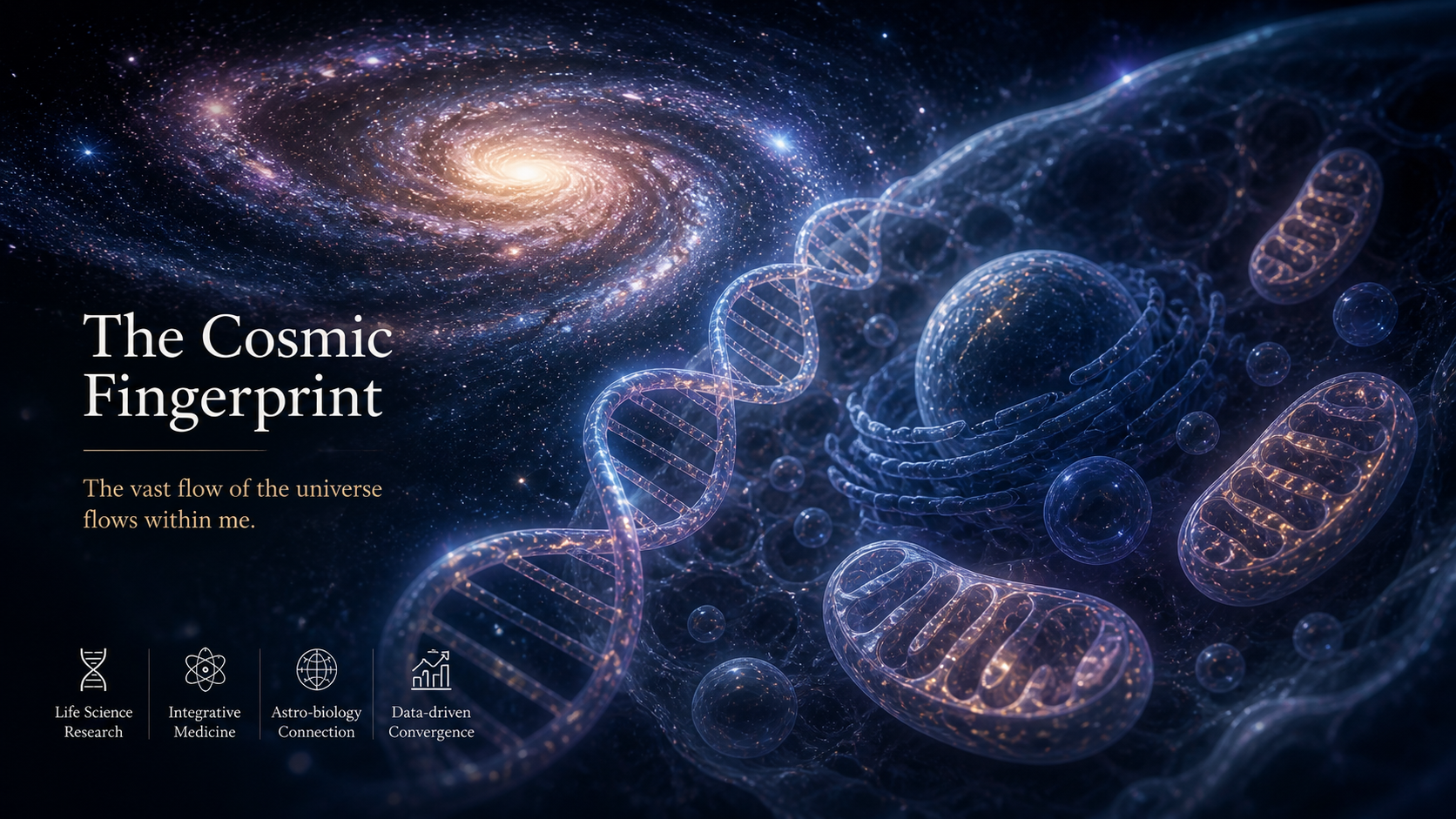
Every cell in your body keeps time. Not metaphorically — there is a molecular oscillator running inside your tissues, and it was built to match the turning of a planet.
That fact earned a Nobel Prize in 2017. It was also, in a different vocabulary, the organizing assumption of East Asian thought for two thousand years: that a human being is a small system nested inside a much larger one, and that health consists of staying in step with it.
The Molecular Clock: What the 2017 Nobel Prize Found
The Nobel Prize in Physiology or Medicine that year went to Jeffrey Hall, Michael Rosbash, and Michael Young for working out the genetic machinery of the circadian clock. The mechanism is elegant. A gene called period (PER) produces a protein that accumulates through the night. As it builds up, it feeds back and shuts down its own production. Then it degrades, the brake releases, and the cycle starts again — a self-winding loop that takes roughly 24 hours. A second protein, cryptochrome (CRY), partners with it to stabilize the rhythm.
This oscillator does not merely tell you when to feel sleepy. It gates when cells divide, when DNA repair enzymes are most active, when the liver processes fats, when hormones release. A large fraction of your genome is expressed on a daily schedule.
Which is why disruption is costly. Shift work, chronic late nights, and light at the wrong hour desynchronize tissues from one another — the liver running on one schedule while the brain runs on another. Long-term circadian disruption has been associated with metabolic disorders, cardiovascular problems, and impaired immune function.
順天者存, 逆天者亡
Mencius put the same principle in five characters.
順天者存, 逆天者亡.
Those who follow the way of heaven survive; those who go against it perish. Mencius
It reads as moral counsel, and it was. But in the classical worldview “heaven” (天) was not an abstraction — it meant the actual order of the sky: the alternation of day and night, the progression of the seasons, the movement of sun and moon. Following heaven meant arranging a life to match observable celestial cycles.
The Huangdi Neijing turned this into instruction: live in accordance with yin and yang (法於陰陽), keep regular hours (起居有常). The unity of heaven and humanity (天人合一) was less mysticism than a working model — the body understood as a subsystem that fails when it drifts out of phase with the system containing it.
The Layer Modern Life Forgets: Seasons
Circadian research gets the daily cycle a great deal of attention. The classical tradition tracked a second layer as well — the year.
The East Asian calendar divided the solar year into twenty-four solar terms (二十四節氣), each with its own guidance on what to eat, how to work, and when to rest. The instruction was not the same in the depth of winter as at the height of summer. Emerging research on seasonal variation in human immune function and gene expression suggests our physiology does shift across the year, though this remains a younger field than circadian science. We looked at one worked example of seasonal practice in the piece on eating hot food in high summer.
Modern indoor life has flattened both layers. Artificial light erases the day; climate control and year-round supply erase the season. We have made ourselves comfortable by removing precisely the signals our clocks evolved to read.
What happens when those signals are removed entirely is not a thought experiment — astronauts live it, and their bodies show measurable acceleration of aging markers. We covered that research in the piece on why astronauts age faster.
Re-synchronizing: What Actually Works
- Morning light: Get outdoor light early in the day. Light is the dominant signal that sets the master clock, and outdoor illumination is far stronger than indoor lighting even on an overcast day.
- Dim the evening: Bright light late at night pushes the clock later. Lowering household lighting in the hours before bed does more than most sleep gadgets.
- Anchor your meals: Eating times entrain the clocks in the liver and gut. Keeping meals roughly consistent — and avoiding very late eating — helps the peripheral tissues stay in phase.
- Keep wake time steady: A consistent rising hour stabilizes the whole system more effectively than a consistent bedtime.
- Let the seasons in: Eat what is actually in season, and allow your activity level and sleep duration to shift somewhat across the year rather than forcing a fixed routine.
Frequently Asked Questions
What did the 2017 Nobel Prize actually discover?
Hall, Rosbash, and Young identified the feedback loop of clock genes — chiefly period and cryptochrome — that generates a self-sustaining daily rhythm inside cells.
Does circadian disruption really affect health?
Long-term disruption, as in sustained shift work, has been associated in numerous studies with metabolic, cardiovascular, and immune problems. Occasional late nights are a different matter from years of inverted schedules.
Is there evidence for seasonal effects on the body?
There is research indicating seasonal variation in immune-related gene expression and other physiological measures. It’s a legitimate and active area, though less settled than circadian biology.
What does 順天者存 mean in practice?
Concretely: don’t invert day and night, keep regular hours, and let your habits shift with the seasons rather than holding one fixed routine against them.
Closing Thought
There is something worth sitting with in the fact that a molecular biologist and Mencius end up giving the same advice. One arrived by isolating genes in fruit flies; the other by watching the sky and human beings for a lifetime. Neither was talking about mysticism. Both were describing a small system that works properly only while it stays in step with a larger one. The sun will keep its schedule regardless. The only variable is whether we keep ours.