
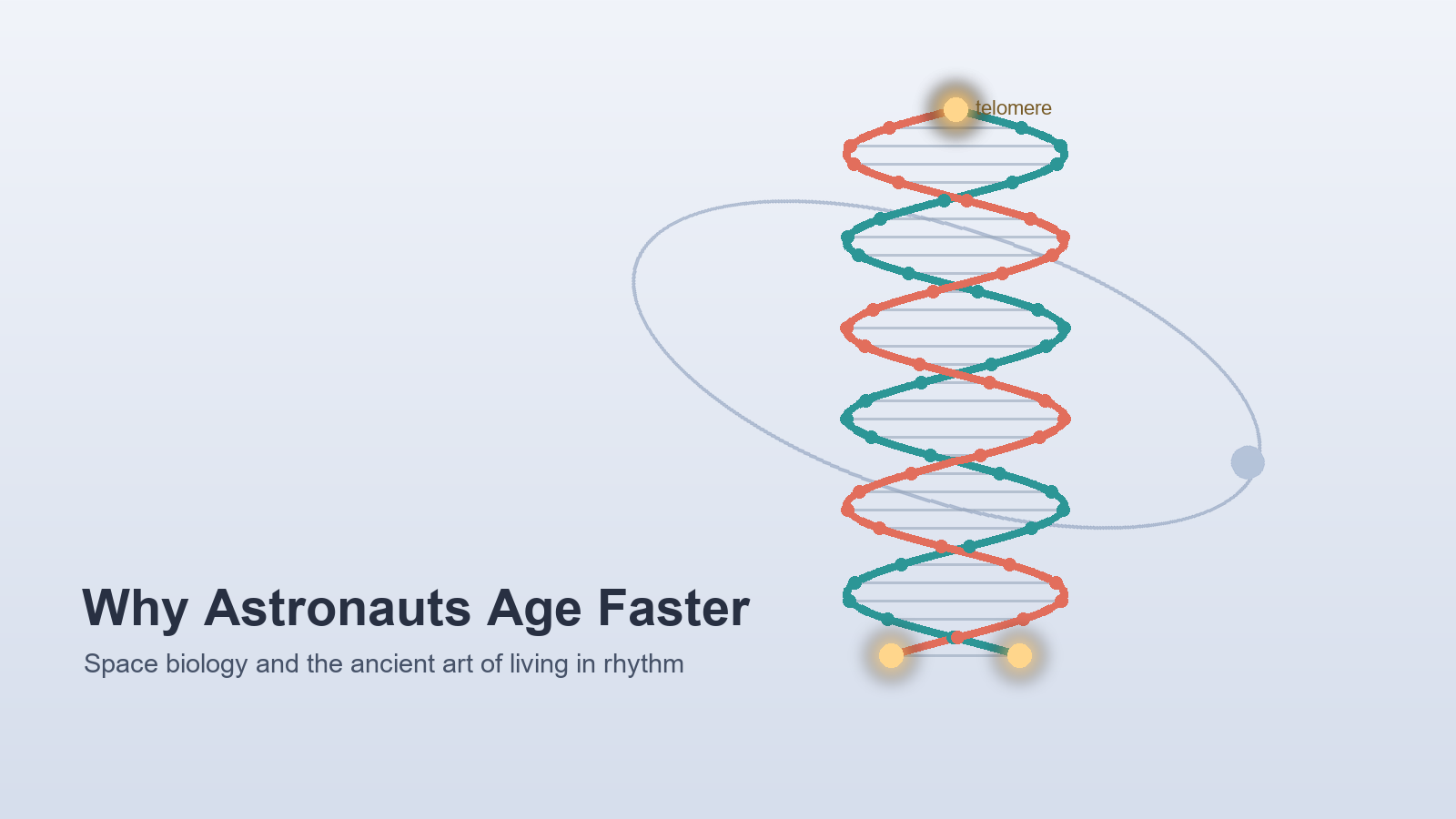
There were two identical twin brothers. One spent a year aboard the International Space Station; the other stayed on Earth. This is the story behind NASA’s famous “Twins Study” — astronaut Scott Kelly and his brother Mark Kelly. When Scott returned from space a year later, his body had grown subtly different from his earthbound brother’s — right down to the DNA. And the reason for that difference echoes, with striking fidelity, something Eastern medicine had already said 2,000 years ago.
Space Shakes the Body’s Clock
Something strange happened to Scott Kelly’s body in orbit. His telomeres — the caps that protect the ends of our DNA — actually grew longer in space. That’s odd, because telomeres normally shorten as we age. But within days of returning to Earth, those same telomeres rapidly shortened and frayed. It was the mark of a body thrown into turmoil by extreme environmental change.
More recent research is blunter still. In 2026, researchers at UC San Diego confirmed that spaceflight accelerates the aging of human stem cells, and a 2026 paper in the journal Aging Cell treats astronauts outright as a “fast-forward model of human aging.” Even after short missions, the activity of genes that maintain telomeres (such as POLD2 and TPP1) was found to be suppressed. In many respects, in other words, space is an environment that ages the body faster.
Why? Because the Body Loses Its Own Rhythm
So why does aging speed up in space? The key is that the body loses the environment — and the rhythm — it evolved to live inside.
On Earth, our bodies are built to run under gravity, following the light of day and night, within a 24-hour rhythm. In space, gravity disappears (microgravity), the light environment is distorted into a day where the sun rises and sets sixteen times, and the body is exposed to intense cosmic radiation. The natural rhythms the body used as its reference points are thrown into disarray all at once. As a result, the cells’ maintenance-and-repair systems fall into confusion, and many markers of aging worsen quickly. The environment was never just a backdrop — it was part of the very system that keeps our bodies in good repair.
What the Huangdi Neijing Said 2,000 Years Ago
Remarkably, the classic of Eastern medicine, the Huangdi Neijing (黃帝內經, The Yellow Emperor’s Inner Canon), pointed to this very principle long ago. Its opening passage describes the secret of long life this way: live “in accordance with yin and yang” (法於陰陽), with “regularity in daily life” (起居有常). Align your body with the rhythms of nature — day and night, the four seasons, the cycles of sun and moon — and keep regular hours for sleeping, rising, and eating.
Eastern thought holds an old idea called “the unity of heaven and humanity” (天人合一) — that the natural world and the human being are connected as one. The body is healthy when it resonates with the rhythms of the cosmos, and falls ill and ages when it strays from them. People thousands of years ago expressed this in the language of philosophy and medicine; today, the astronaut’s body demonstrates the inverse experimentally — how quickly the body deteriorates when it leaves nature’s rhythm entirely.
Practicing “Rhythm Yangsheng” on Earth
We don’t go to space, but modern city life quietly turns us into “little astronauts.” Lights burning through the night, irregular sleep, a lifestyle that has forgotten the seasons — all of it slowly rattles the body’s natural rhythm. Carry the wisdom of the Huangdi Neijing into today’s habits, and it looks like this.
- Keep the rhythm of light: Get bright sunlight in the morning, and dim your lights at night. Light is the most powerful signal for setting the body’s clock.
- Regular rising and sleeping (起居有常): Keep your sleep and wake times as consistent as you can. Rhythm is born of regularity.
- Eat with the seasons: Choosing seasonal foods is an age-old way of tuning the body to nature’s cycles.
- Touch the earth: Get outside to walk or be in nature at least once a day. It’s the very “connection to Earth” that astronauts lose.
Frequently Asked Questions
If telomeres lengthened in space, doesn’t that mean astronauts got younger?
No. They lengthened temporarily but shortened sharply after return, and that kind of rapid swing is itself a stress on the body. The conclusion of recent research is that, overall, the space environment acts to accelerate aging.
How does astronaut aging research help us here on Earth?
Because space shows aging in “fast-forward,” it makes a useful model for studying the aging process over a short period. Anti-aging countermeasures learned there can potentially be applied as anti-aging therapies on Earth.
Does keeping a biological rhythm really affect aging?
Yes. The regularity of sleep, light, and meals (your circadian rhythm) has wide-ranging effects on metabolism, hormones, and cellular repair, and chronic rhythm disruption has been studied in connection with various health problems and aging-related markers.
What does the Huangdi Neijing’s “living by yin and yang” concretely tell us to do?
In simple terms, “don’t fight nature’s rhythm.” Rather than flipping your rhythm — awake at night, asleep by day — align your life with the cycles of the seasons and of night and day. It’s a practical guideline, not just a poetic one.
Closing Thought
The astronaut’s story offers us an unexpected lesson: the human body is built to stay in best repair within one particular rhythm — that of Earth — and the moment it leaves that rhythm, the clock of aging speeds up. When the Huangdi Neijing said, two thousand years ago, to “follow the rhythms of nature,” it may not have been poetic advice at all, but a precise observation about how our bodies actually work. Turning the lights off a little earlier tonight, and catching some sunlight tomorrow morning — that is the oldest anti-aging prescription available to those of us with our feet still on the ground.