
You drank water today. So did I.
And there’s a good chance that water carried tiny, invisible fragments of plastic. Research published in July 2026 raised the possibility that the nanoplastics riding in our drinking water may even help harmful bacteria survive — by strengthening the protective films (biofilms) the bacteria use to shield themselves.
For thousands of years in the East, water was the source of life and the very symbol of the highest virtue. And now we drink it filled with the most artificial substance we’ve ever made, too small to see. Standing before that irony, an old line from Laozi asks to be read again.
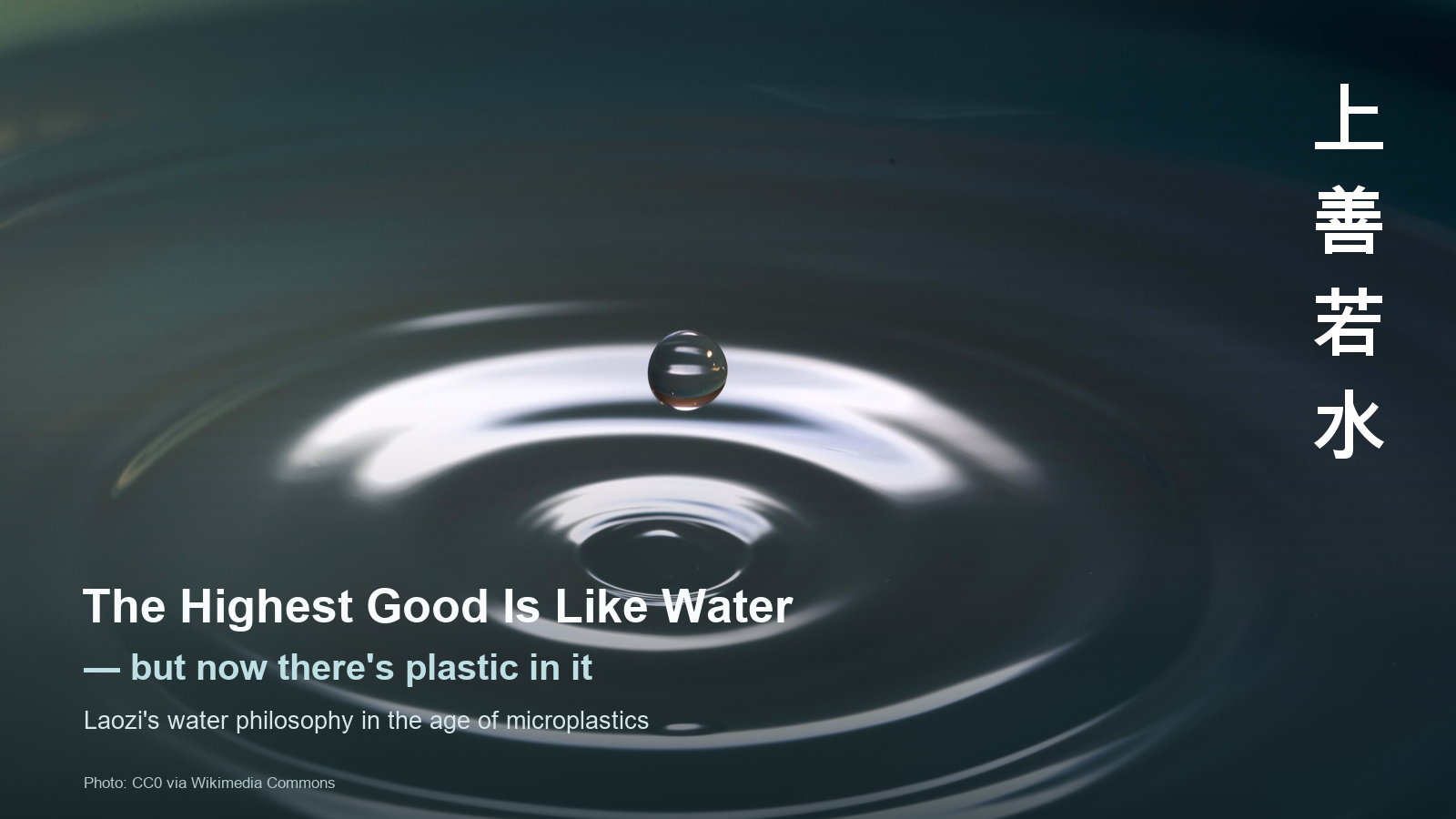
Shang Shan Ruo Shui: The Highest Good Is Like Water
The opening of Chapter 8 of Laozi’s Tao Te Ching reads:
“上善若水” (shang shan ruo shui)
— The highest good is like water.
Laozi goes on: water benefits all things yet contends with none, and it dwells in the low places everyone else disdains. Soft, yet in the end it overcomes the hard; lowering itself, it rises to the highest place. This is why water was considered the thing nearest to the Tao.
Water was special throughout Eastern thought. The starting point of nourishing life (養生) was always clean water and clean air; tea culture began with the search for good water; traditional medicine weighed even the nature and temperature of water. Water was not a mere resource but the ground of life and spirit.
And that water has now become the carrier of the most artificial material humanity ever created. The thing that should be purest has come to hold the thing most invisible.
More Frightening Because It’s Invisible
Microplastics — and the even smaller nanoplastics — are now being detected not just in drinking water but in human blood, in the placenta, even in the brain. They enter us through the things we meet every day: bottled water, tap water, seafood, salt.
Here honesty matters. Exactly how much harm microplastics do to the human body, and in what ways, is still being actively researched and is far from settled. There’s no need to stoke fear. But the trajectory looks clear enough: the water we revered as the source of life is quietly becoming a channel for contamination — and the cause is none other than ourselves.
Do Not Foul the Source You Drink From
Here an old Eastern wisdom rings out again. Nourishing life always began less with “what do you add” than with “what do you keep from fouling.” The attitude that not letting bad things in comes before taking good medicine.
There’s a theme this site has returned to many times: the body sickens and ages when it fights the rhythm of nature. The microplastics problem is that principle at its largest scale. Over the past century, absorbed in mastering nature, humanity forgot one of the oldest rules: don’t foul the spring you drink from. When Laozi called water the highest good, it may not have been romance but a cold recognition — that water simply is the condition of life.
Practicing “Protecting Water” Today
In the face of an enormous environmental problem, what one person can do may look small, but there are concrete ways to reduce exposure.
- Glass or stainless steel instead of plastic bottles: PET-bottled water exposed to heat or sunlight can shed more plastic particles.
- Use a water filter: Some filters remove a substantial share of microplastics. Choose one suited to your local water.
- Avoid heating food in plastic: Don’t microwave food in plastic containers; put hot food and drinks in glass or ceramic.
- Boiling: Some studies find that boiling water can precipitate and remove some microplastics. The East’s long habit of drinking tea turns out to carry an unexpected benefit.
- Reduce plastic use itself: Ultimately the root is using less — reducing what comes into you and what you send out into the world at the same time.
Frequently Asked Questions
Are microplastics really harmful to health?
It’s confirmed that they’re detected in blood and organs, but their precise long-term effects on the body are still under research. Rather than settled fear, a preventive attitude of reasonably reducing exposure is appropriate.
Does boiling water remove microplastics?
Some studies find that boiling — especially hard water (high in minerals) — can remove a significant amount of microplastics along with the precipitate. It doesn’t eliminate them entirely, but it can help reduce them.
Is bottled water worse than tap water?
It varies by study, but there are cases where substantial amounts of micro- and nanoplastics were detected in bottled water. If your local tap water is good, filtering it and drinking from glass is a fine choice.
What exactly does “shang shan ruo shui” mean?
It means “the highest good is like water” — Laozi’s teaching that takes water’s nature (benefiting all things without contending, dwelling in low places) as the ideal for how to live.
Closing Thought
Laozi looked at water and saw the highest good: contending with nothing, flowing to the low places, giving life to everything. Twenty-five centuries later, we look into that water again — this time through a microscope. And something we made is drifting inside it. The lesson is simple. The more precious a thing is, the less we can afford to be careless in protecting it. It might be worth looking a little differently at the glass of water you drink today.
What the latest research says about microplastics in the body
Since this article was first written, the evidence has moved from “concerning” to “hard to ignore.” In 2024, researchers reported nanoplastic particles in bottled water at roughly 240,000 particles per liter — far more than earlier microplastic estimates (Qian et al., PNAS, 2024). Microplastics have now been documented in human blood (Leslie et al., Environment International, 2022), the placenta (Ragusa et al., 2021), and even arterial plaque.
Most striking, a 2024 study in The New England Journal of Medicine (Marfella et al.) found that patients whose carotid artery plaque contained micro- and nanoplastics had a markedly higher risk of heart attack, stroke, or death over the following ~34 months. This is among the first human data linking plastic particles to a hard clinical outcome — though it shows association, not yet proven causation.
How to reduce your exposure
- Prefer filtered tap water to bottled water; a simple carbon or reverse-osmosis filter cuts particle counts.
- Don’t heat food in plastic. Microwaving plastic containers can release large numbers of particles — transfer to glass or ceramic first.
- Reduce single-use plastics and avoid leaving bottled water in hot cars.
- Choose natural fibers where practical; synthetic textiles shed microfibers in every wash.
Frequently asked questions
Is bottled water worse than tap? On nanoplastics, current evidence suggests bottled water often contains more, not less.
Can I remove microplastics already in my body? There is no proven method; the practical goal is lowering ongoing intake.
How does this connect to 上善若水? Laozi praised water as the highest good because it benefits all things. The warning today is that what we return to the water eventually returns to us.