
The most-watched story on Earth right now is a 2,700-year-old poem.
Christopher Nolan’s The Odyssey opened to $264.1 million worldwide, the biggest global debut of his career, and its 96% critics’ score on Rotten Tomatoes is the best he’s ever had. Matt Damon, Tom Holland, Robert Pattinson, and Zendaya have walked into Homer’s epic.
And yet the most radical scene in the story isn’t in the trailer. It’s the moment the hero is offered eternal life — and turns it down.
A Goddess’s Offer, and a Refusal
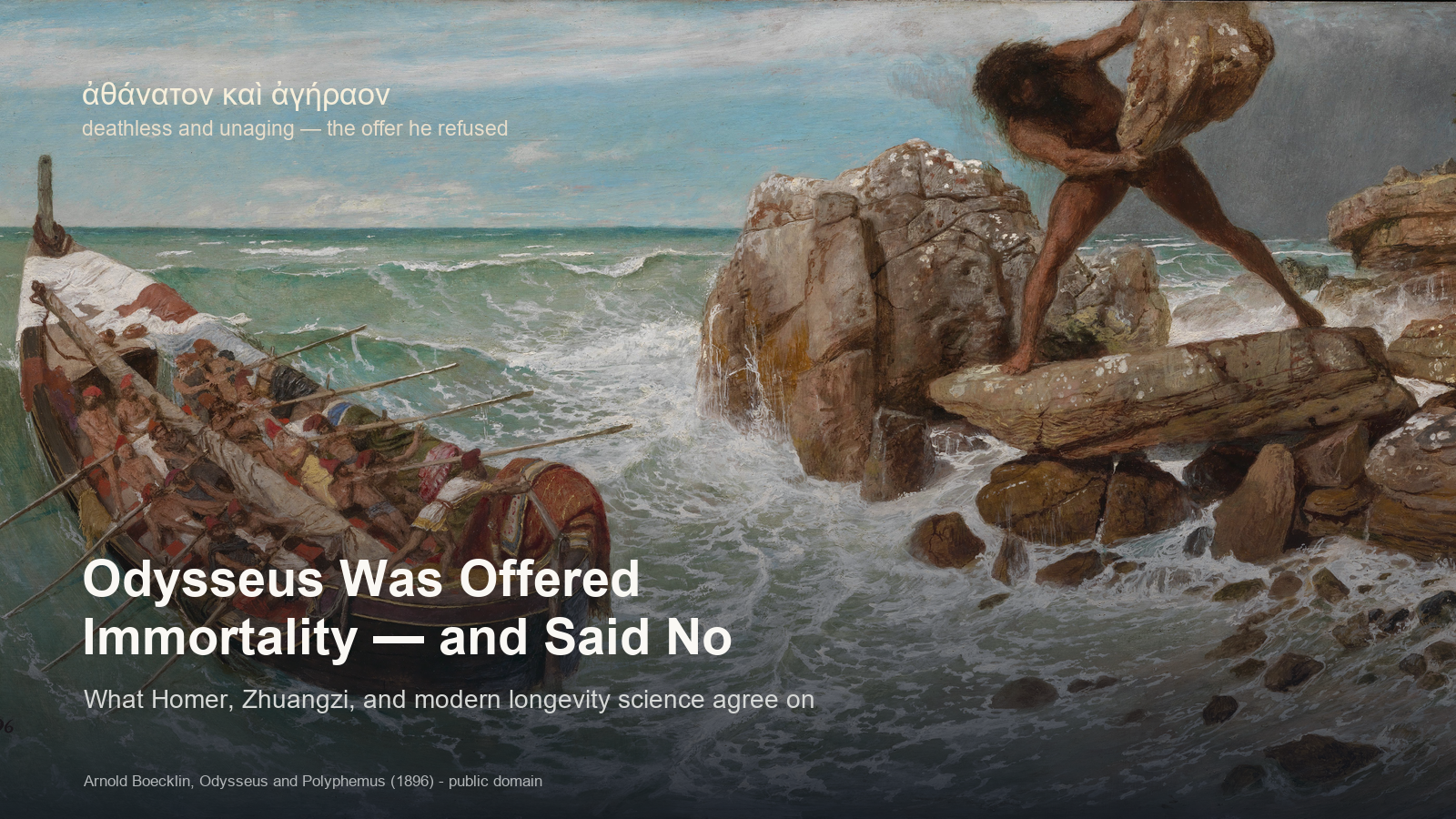
Book 5 of the Odyssey. Odysseus has been held on the goddess Calypso’s island for seven years. She loves him, and at last she offers him the greatest thing she has: stay with her, and she will make him “deathless and unaging” (ἀθάνατον καὶ ἀγήραον). It is the final form of every wish humanity has ever imagined.
Odysseus refuses.
He tells the goddess plainly that he knows his wife Penelope cannot match her beauty — that a mortal woman is no comparison to one who never ages. And still, he says, every day he longs to go home. He chooses, over immortality, a wife who will grow old and die, and a small rocky island called Ithaca.
He could live forever, and he insists on going somewhere he will die.
The East Wanted Precisely the Opposite
Set that choice beside the stories of the East and its strangeness sharpens.
In 219 BCE, Qin Shi Huang gave the alchemist Xu Fu a fleet and thousands of people and sent him beyond the eastern sea to the Three Sacred Mountains — to bring back the elixir of immortality. For centuries the xian (神仙) tradition pursued immortality and eternal youth (不老長生). Taoist practitioners brewed elixirs, disciplined the breath, and dreamed of ascending as immortals.
One civilization refused a goddess’s free gift of immortality. The other crossed oceans and staked dynasties trying to obtain it. (I wrote about that pursuit in detail in the piece on Starship and the Taoist immortals.)
But Go Deeper, and the Two Traditions Meet
It would be a misreading to conclude too quickly that “the West accepted finitude while the East was obsessed with immortality.” The deeper layer of Eastern thought stands in exactly the same place as Odysseus.
Zhuangzi left us the famous story of drumming on a pot and singing after his wife died. He saw life and death as the turning of the four seasons, and taught to “rest in the moment and follow the course of things” (安時處順). Death was not an enemy to be refused but a natural transformation to be met.
Confucius was blunter. When a disciple asked about death, he answered: “未知生, 焉知死” — not yet understanding life, how could we understand death? Turn your gaze away from the beyond and back to the life and relationships in front of you.
And look at the word yangsheng (養生) itself. It means nourishing life, not extending it without limit. It was the art of filling the span you’re given, completely. The fantasy of never aging was the popular, shallow layer of that tradition; beneath it there was always a firmer floor: live this life well.
In the end Homer, Zhuangzi, and Confucius say the same thing in different languages. What matters is not how long you live, but what you belong to.
The Twist Modern Research Adds
Here’s where it gets interesting. What Odysseus chose instead of immortality — a wife, a home, belonging — turns out to be exactly what modern longevity research points to most consistently.
Long-running studies like the Harvard Study of Adult Development, which followed people for decades, report that the strongest predictor of a long and healthy life wasn’t cholesterol or wealth but the quality of one’s relationships. Social isolation is now treated as a health risk on the order of smoking, and a sense of purpose is repeatedly linked to lower mortality.
Meanwhile the center of gravity in aging science has been shifting from lifespan to healthspan — not how long you hold out, but how long you keep functioning fully.
Odysseus is a figure of myth, but his choice was remarkably well-evidenced. He declined the seductive option of immortality and picked the single most powerful longevity factor we can measure.
Practicing It Today
Brought down into daily life, it looks like this.
- “How fully” over “how long”: Move some of the attention you give to the newest supplement or biohack back toward the basics — sleeping well, moving often, connecting well.
- Invest time in relationships: Calling an old friend isn’t a sentimental gesture; it’s evidence-based health care.
- Build somewhere to return to: Odysseus’s Ithaca was not a glamorous place. A small daily life that gives you belonging is enough.
- Don’t deny finitude: As in Zhuangzi’s attitude, the fact that there’s an end is what brings the present into focus.
Frequently Asked Questions
Why did Odysseus refuse immortality?
In Homer’s telling, he wanted to return to his wife Penelope and his homeland of Ithaca. It’s read as choosing human belonging and homecoming over divine eternity.
Was the East really obsessed with immortality?
The popular xian tradition and elixir-seeking certainly existed, but the core of both Confucian and Taoist philosophy lay in living a finite life well — Zhuangzi’s 安時處順 and Confucius’s “未知生, 焉知死” being the clearest examples.
Do relationships really affect lifespan?
Long-term studies such as the Harvard Study of Adult Development report that relationship quality is a powerful predictor of long-term health and happiness, and the risks of social isolation have been confirmed repeatedly across studies.
Is this scene in Nolan’s film?
It’s a pivotal moment in Book 5 of the original, so it’s likely to be addressed, though where a director places emphasis is always their choice. It’s worth watching for the Calypso sequence.
Closing Thought
There’s probably a reason a 2,700-year-old poem is the biggest thing in theaters today: the question Odysseus asked is still ours. We live in the era that works harder than any before it to slow down aging, and that effort is admirable. But every so often it’s worth asking the other question: what am I hoping to live long for? Odysseus could refuse eternity because he already knew his answer.