
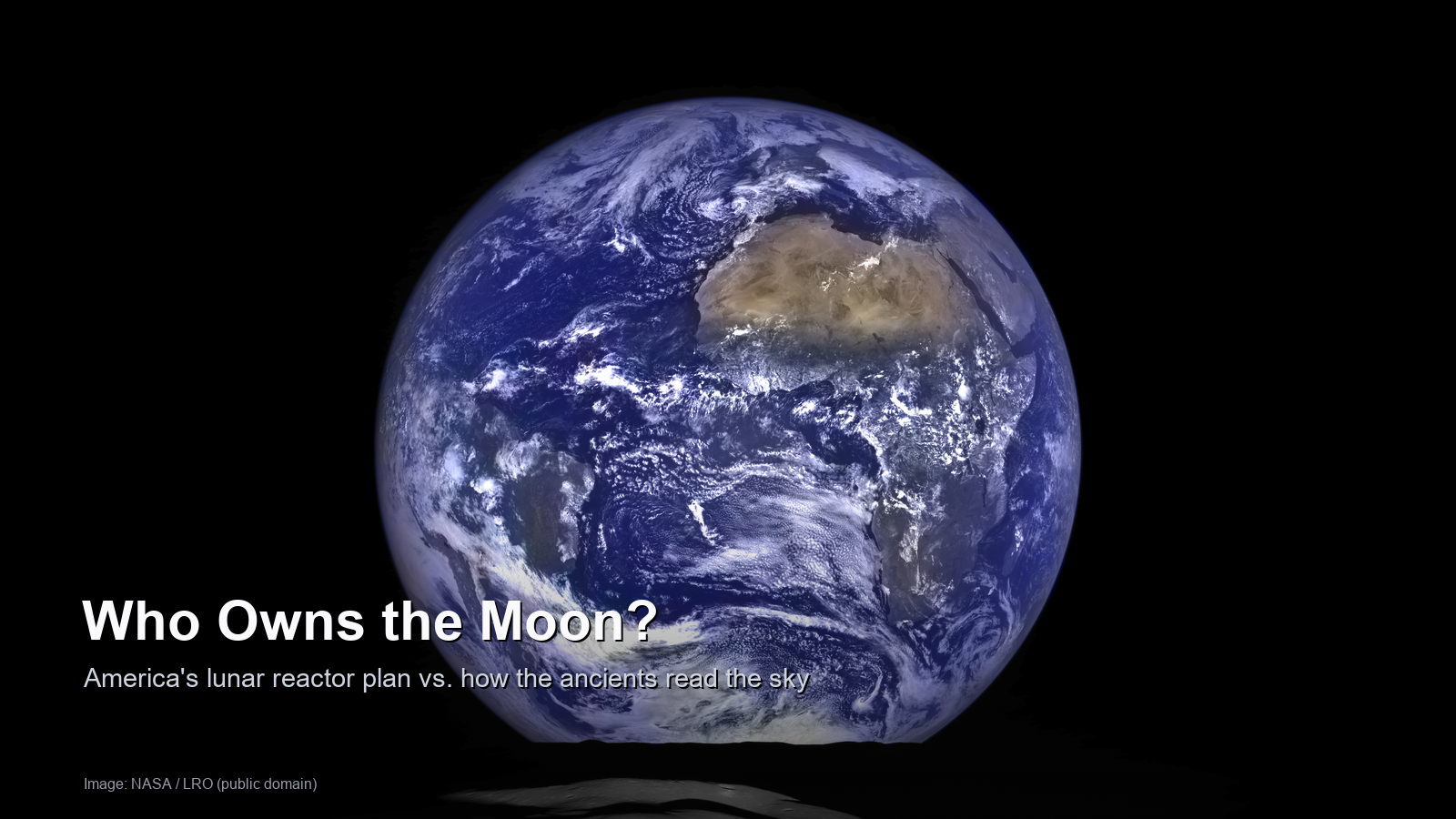
“A nuclear reactor on the Moon by 2030.” That’s the plan recently laid out by Sean Duffy, the acting administrator of NASA. The motive is stated bluntly — to plant a foothold on the Moon before China and Russia. There’s even open talk that whoever arrives first could declare a “keep-out zone,” blocking other nations from entering.
For most of human history, people looked up at the Moon and saw a symbol — the turning of time, the force of yin, longing, impermanence. But in 2026, we look up at the same Moon and increasingly see something else: territory, and inventory. Helium-3 said to be worth some $4 billion a ton, rare earth metals, and a scramble over who gets there first.
An ancient astronomer would probably have found the question itself strange. Who owns the Moon?
What’s Happening Now: A Space-Resource Race Becomes Policy
In 2026, the race for the Moon has become, quite literally, national policy. Under Duffy’s directive, NASA has set a goal of placing a 100-kilowatt nuclear reactor on the lunar surface by 2030, preceded by a space fission-power demonstration reactor, “SR-1 Freedom,” to launch by late 2028. All of it is part of the Artemis program to build a permanent lunar base. The reason for the hurry is singular: China and Russia have announced a joint reactor effort targeting the mid-2030s, so the aim is to arrive first and hold the advantage — and the keep-out zone.
And it isn’t only nations. Private companies, including the likes of SpaceX, are eyeing lunar resources too. The biggest prize among them is helium-3. Nearly absent on Earth but abundant in lunar soil, this isotope is regarded as a theoretically ideal fuel for clean nuclear fusion, with a potential value cited at roughly $4 billion per ton. Beyond it lie rare earth metals essential to electronics, and water ice trapped in the permanently shadowed craters of the lunar south pole — raw material for rocket fuel.
Firms like Interlune, ispace, and Magna Petra are developing autonomous robots, solar-powered excavators, and AI processing systems. Interlune, founded by a former NASA engineer, has already secured funding and set a 2027 prospecting mission and a 2029 pilot plant. The Artemis Accords, signed by over 40 nations, have opened a path for private companies to commercially extract and use lunar resources.
The problem is that there are still no clear international rules for who the Moon belongs to. Does it go to whoever plants a flag first? In that vacuum, humanity is carrying the logic of earthly resource-grabs straight up into the sky.
The Ancient East Did Not See the Sky as Something to Own
Set the old Eastern view of the heavens beside this, and the strangeness sharpens.
In the East, heaven (天) was not something to be owned or conquered, but an order to be read and followed. The ancient Chinese astronomical-mathematical classic the Zhoubi Suanjing (周髀算經) measured the movements of the sun, moon, and stars and sought to understand the structure of heaven and earth through geometry. Its aim was not to dominate the sky but to know its principles so that human life — farming, the seasons, ritual — could be aligned with its rhythm.
The Moon in particular was special. It set the lunar calendar, moved the tides, and taught time and impermanence through its waxing and waning. In Eastern thought the Moon was the Great Yin (太陰), a symbol of the cosmos’s rhythm — not a resource to be dug up. The human task was to observe its principle and accord with it (順天).
From that ancient vantage, “who owns the Moon” doesn’t even parse. The Moon was never in the category of things one could own.
The Way of Heaven vs. the Way of Man: Laozi’s Warning
So what changed? Eastern philosophy might frame it as the divergence of the Way of Heaven (天道) and the Way of Man (人道). The Way of Heaven reduces what is excessive and fills what is lacking (天之道, 損有餘而補不足); the way of man often runs the opposite direction — those who already have, reaching for more.
Of this endless wanting, Laozi is blunt in Chapter 46 of the Tao Te Ching:
“禍莫大於不知足” (huo mo da yu bu zhi zu)
— There is no disaster greater than not knowing when you have enough.
The line was written 2,500 years ago, yet it feels uncannily timely as rockets rise toward a $4-billion-a-ton Moon. The engine underneath the lunar rush is, in the end, “more” — and “before anyone else.” It is exactly the not-knowing-enough (不知足) that Laozi called a disaster.
Let’s not misread this. It isn’t a condemnation of space exploration itself. Humanity’s longing to press into the unknown is genuinely marvelous — just as I wrote in the piece on Starship. The question isn’t the exploration. It’s the gaze we bring to the sky — whether we look with wonder, or with a calculator.
Your Own Sky: Where Does Your “Not-Enough” Point?
Here the story turns unexpectedly back to each of us. The not-enough aimed at the Moon springs from the same root as the not-enough in our daily lives: more achievement, more possession, more approval — a mind that never quite arrives at “enough.” What Laozi called a disaster is not only a matter for nations and corporations, but a daily matter for me.
- Define “enough”: Try writing down where “this is enough” sits in your own life. Contentment (知足) isn’t resignation — it’s the choice to step down from an endless thirst.
- Look at the sky without a calculator: Sometimes see the Moon as neither resource nor target, but simply the Moon. A sense of wonder is genuinely good for mental health.
- Practice subtracting: Like the Way of Heaven that fills by reducing, build the habit of looking for what to remove before you add.
- Move with a rhythm: As the Moon waxes and wanes, allow your own activity and rest to cycle too.
Frequently Asked Questions
Is mining the Moon’s resources actually feasible?
Technologically it’s early-stage. Helium-3 fusion is not yet a commercialized technology, and mining and transport costs are enormous. Water ice and rare earths are discussed as more realistic near-term targets.
Can a nation or company own the Moon?
The 1967 Outer Space Treaty says no state may claim sovereignty over a celestial body. But the rules on “extracting and using resources” are ambiguous, and the Artemis Accords’ opening for commercial use is contested.
What is the Zhoubi Suanjing (周髀算經)?
One of China’s oldest astronomical-mathematical classics, treating the structure of heaven and earth and the movement of celestial bodies through gnomon-shadow measurements. It represents the Eastern view of the sky as something to understand and harmonize with, not to dominate.
Why is “not knowing enough” a disaster?
Laozi held that a mind that never feels satisfied breeds endless strife and destruction — a source of unhappiness for the individual, and the root of resource conflict for groups.
Closing Thought
The Moon has hung there for billions of years, indifferent to whatever we call it — symbol, or $4-billion inventory. What changes is not the Moon but the ones looking up at it. The ancient astronomer saw in it a principle to follow; we increasingly see a resource to claim. Which eye we bring to the sky — that choice lies not up there, but here, inside us, right now.