
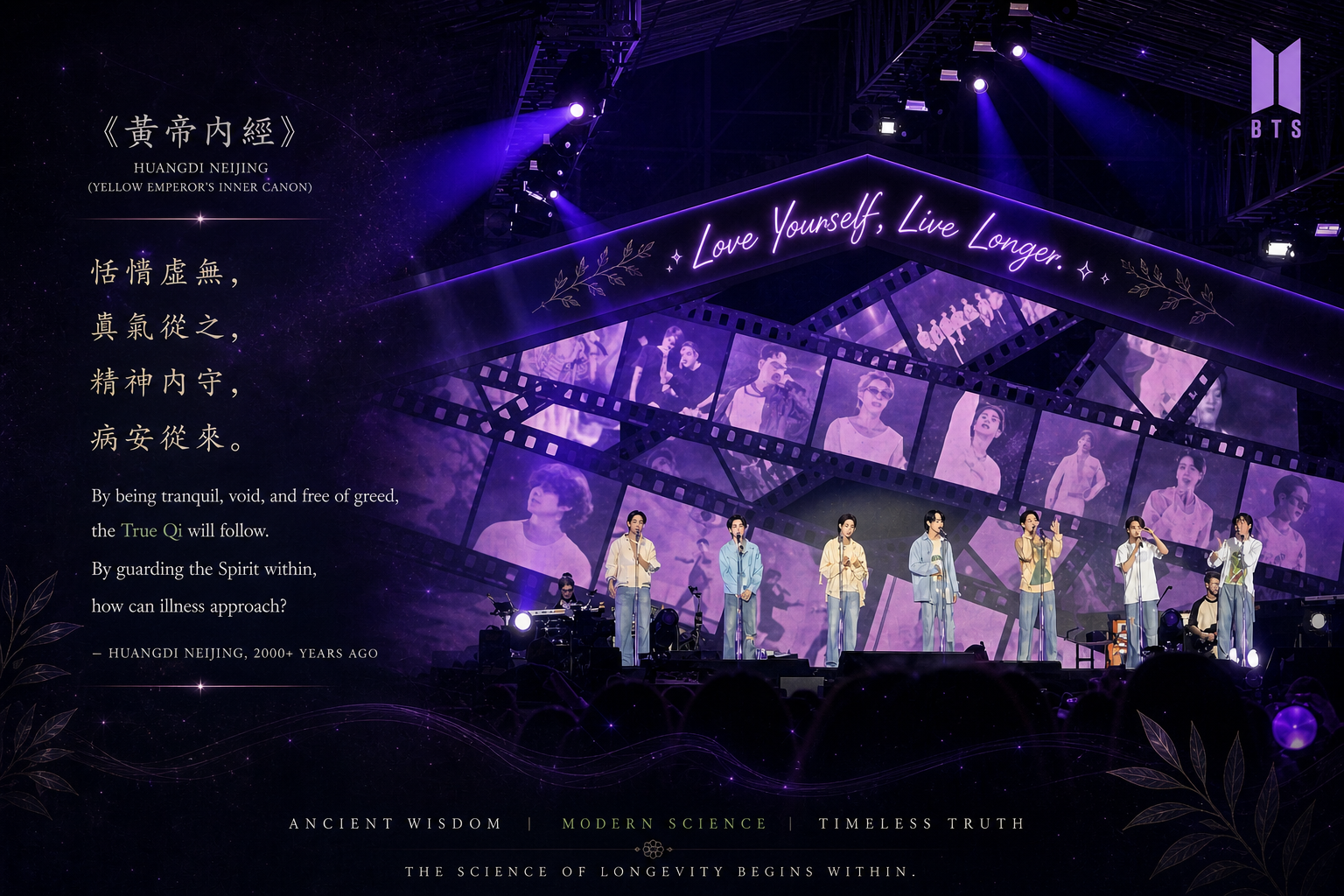
When BTS built a global campaign around the phrase “Love Yourself,” it was received as a piece of modern pop psychology — warm, encouraging, and a little abstract. A message about self-acceptance for an anxious generation.
But the instruction is much older than that, and in its oldest form it was not primarily emotional advice. It was medical. The Huangdi Neijing (黃帝內經), the foundational text of East Asian medicine, opens with a passage that describes guarding the self as a precondition for health — and modern research on stress physiology has been quietly confirming the logic ever since.
The Passage That Reads Like a Manifesto
In the opening chapter, “On the Heavenly Truth of High Antiquity” (上古天眞論), the Inner Canon sets out what allows a person to live out their natural span in good health.
恬惔虛無, 眞氣從之, 精神內守, 病安從來.
Tranquil, unhurried, free of grasping — the true qi follows. Guard the spirit within, and where would illness come from?
Two phrases carry the weight. 恬惔虛無 describes an inner state that is calm and free of restless craving. 精神內守 — “guard the spirit within” — asks you to keep your attention anchored inside rather than scattered outward, chasing approval, comparison, and the endless judgments of others.
That second phrase is the ancient version of what BTS said in three words. Not self-indulgence, and not narcissism — the text is quite specific. It’s the discipline of not leaking your attention outward until nothing is left holding you together.
Why This Was Considered Medicine, Not Sentiment
It’s easy to read that passage as poetry. The authors did not. In the framework of the Inner Canon, emotional turbulence was a direct cause of physical disease. Anger was said to injure the liver, excessive worry the spleen, fear the kidneys. Whatever we make of the organ correspondences, the underlying claim is unambiguous: a mind in chronic agitation makes a body ill.
So the prescription was not “feel better.” It was to remove the conditions that keep the system in a state of alarm — because a body under constant alarm cannot do its maintenance work.
What Modern Research Says About the Same Idea
Here the ancient claim turns out to be unusually well-supported.
Chronic psychological stress keeps cortisol elevated, and sustained cortisol elevation is associated with impaired immune function, disrupted sleep, and higher inflammatory markers. Chronic low-grade inflammation — sometimes called “inflammaging” — is now one of the most discussed drivers of biological aging.
Research on self-compassion is more specific still. People who score higher on self-compassion measures tend to show lower cortisol reactivity to stressors and lower markers of inflammation, alongside better psychological outcomes. In other words, how harshly you speak to yourself has measurable physiological consequences. That is close to a literal restatement of 精神內守.
And there’s the social dimension. Long-running studies — the Harvard Study of Adult Development among the best known — find that the quality of a person’s relationships predicts long-term health better than most conventional risk factors. Self-acceptance is part of what makes those relationships sustainable; a person at war with themselves has less to offer anyone else. We explored a version of this in the piece on Odysseus refusing immortality.
The Part That Gets Lost in Translation
Modern self-care marketing tends to translate “love yourself” as permission — buy the thing, skip the obligation, indulge the impulse. The Inner Canon says something almost opposite. Look again at 恬惔虛無: free of grasping. The passage treats endless wanting as the thing that agitates the system in the first place.
So the classical version isn’t “give yourself whatever you want.” It’s closer to “stop needing so much from the outside that you cannot rest.” Self-acceptance, in that reading, is what makes restraint possible rather than what excuses its absence.
Practicing 精神內守 Today
- Notice the outward leak: Track how much of your day is spent measuring yourself against others — social feeds are the obvious place. Reducing that is the most direct application of “guarding the spirit within.”
- Change the inner voice: When you catch harsh self-talk, try addressing yourself as you would a friend. Self-compassion research suggests this isn’t merely pleasant; it registers physiologically.
- Use the breath as an anchor: The classical texts pair inner guarding with breath regulation. A few minutes of slow breathing is the practical entry point — see the five-minute breathing piece.
- Protect sleep and rhythm: A dysregulated schedule keeps the stress system switched on. The Inner Canon’s other core instruction was regularity — more on that in the piece on living in rhythm.
- Want less, not more: The passage names grasping as the disturbance. Removing one source of chronic wanting often does more than adding one more wellness practice.
Frequently Asked Questions
Is “love yourself” really in the Huangdi Neijing?
Not in those words. The text speaks of 精神內守 — guarding the spirit within — and of remaining calm and free of grasping. The overlap with the modern phrase is conceptual, not literal.
Does self-compassion actually affect physical health?
Research links higher self-compassion with lower cortisol reactivity and lower inflammatory markers, along with better psychological outcomes. It is an active research area rather than a settled one, but the direction is consistent.
Isn’t this just telling anxious people to relax?
The classical instruction is more concrete than that: reduce grasping, keep regular hours, steady the breath, and stop scattering attention outward. Those are actions, not moods.
What is 眞氣 (true qi)?
In the Inner Canon it refers to the body’s foundational vitality. You don’t have to accept the traditional metaphysics to use the passage’s practical instruction — calm, regularity, and inner focus have effects we can measure by other names.
Closing Thought
A pop campaign and a two-thousand-year-old medical text arriving at the same sentence is worth pausing over. The Inner Canon was not offering comfort; it was making a claim about causation — that a mind kept in turmoil will eventually present as a body in trouble. Modern stress physiology has been filling in the mechanism ever since. Loving yourself, it turns out, was never only about how you feel. It was about what your body is able to do while you’re feeling it.