
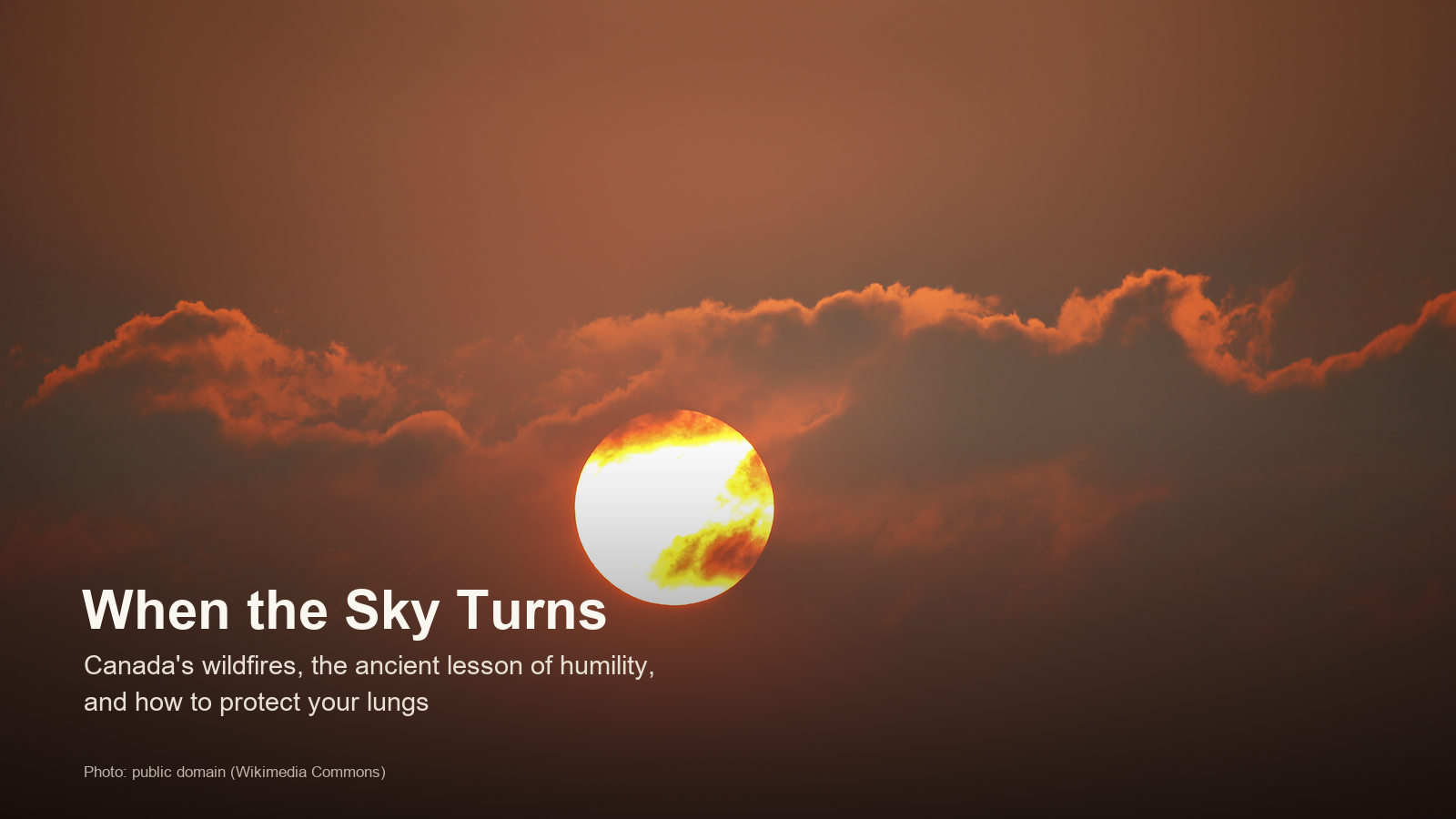
You don’t have to be near a fire to breathe it.
As of July 2026, 796 wildfires are burning across Canada, 60 of them out of control. This season alone has seen 3,137 fires reduce 1.4 million hectares to ash. And the smoke has crossed the border into the American Midwest and Northeast, leaving roughly 100 million people under degraded air quality. The skies above Toronto, Boston, and New York have been swallowed in thick haze, and New York’s air briefly ranked among the most polluted on Earth.
People in cities thousands of kilometers away are breathing the smoke of a fire they never lit. Standing in front of that fact, we find ourselves handed an old question again: what is a human being in the face of nature?
Tian Di Bu Ren (天地不仁): Nature Is Not Cruel — It Is Indifferent
Chapter 5 of Laozi’s Tao Te Ching contains a chilling line.
“天地不仁, 以萬物爲芻狗”
— Heaven and Earth are not benevolent; they treat the ten thousand things as straw dogs.
A “straw dog” was a ritual figure used in ceremonies and then discarded. It sounds brutal, but Laozi’s point isn’t that nature is evil. It’s that nature plays no favorites. It does not hate us, and it does not spare us. A fire does not ask whose house it is; the wind does not calculate whose lungs its smoke will enter.
Humans have long regarded themselves as nature’s exception. Building cities, conditioning the climate, going to space, we came to believe we could stand outside nature’s rules. When wildfire smoke crosses a continent to knock on skyscraper windows, that belief collapses very quietly. We were never the exception.
Fire Was Always Part of the Cycle — the Problem Is the Tempo
There’s something we shouldn’t misunderstand here: fire itself isn’t the villain.
Many forests evolved to burn and grow back. Just as in the Five Phases (五行) fire (火) follows wood (木) and gives way to earth (土), fire was never an interruption of the cycle but a phase within it. Ash enriches soil; some seeds need the heat of fire to crack their coats open. When the Eastern view of nature framed destruction and creation as a single loop, that was observation, not romance.
What has changed is the speed and scale — the rhythm. Hotter, drier seasons have pushed fire past the tempo the land can absorb and recover from. The cycle hasn’t vanished; it has accelerated beyond what the cycle can carry. We’ve said many times on this site that the body ages when it fights nature's rhythm. That principle, it turns out, was never only about bodies. Forests fall ill when they lose their rhythm too.
And Now, Ancient Knowledge Is Being Called Back
The most striking detail in Canada’s own response wasn’t the equipment or the budget. It was that the funding to strengthen wildfire capacity includes projects to integrate Indigenous knowledge into wildfire management — risk mapping, evacuation coordination, and training Indigenous wildland firefighters.
People who have lived with fire on this land for thousands of years knew something: rather than suppressing fire absolutely, you burn small, often, and in season, reducing in advance the fuel that feeds the catastrophic blaze. Long dismissed as superstition or as outdated, that knowledge is now being invited back as a partner to cutting-edge fire science.
Ancient wisdom returning by way of modern verification — the very scene this lab keeps writing about is unfolding in real time, in front of a burning forest.
How to Protect Your Body in the Smoke (Practical Guide)
Philosophy aside, what people living under the smoke need right now is concrete guidance. The core hazard in wildfire smoke is fine particulate matter (PM2.5) — particles small enough to reach deep into the lungs and even into the bloodstream.
- Check the Air Quality Index (AQI) daily: When it’s unhealthy or worse, cut back on going out and on outdoor exercise. Hard exercise especially raises how much air — and smoke — you take in.
- Use an N95/KF94-grade mask: Cloth and surgical masks block little PM2.5.
- Manage indoor air: Keep windows shut and run a HEPA air purifier. Without one, at minimum avoid ventilating during the smokiest hours.
- Vulnerable groups, take extra care: People with asthma or cardiovascular disease, pregnant people, children, and older adults should minimize exposure even without symptoms.
- Listen to your body’s signals: If coughing, stinging eyes or throat, headache, or chest tightness persists, don’t push through — consult a medical professional.
We’ve written often about disciplines that train the breath, but when the air itself is bad, the best practice of nourishing life is simply to breathe less of it. Today, closing the window rather than opening it is the way of yielding to nature.
Frequently Asked Questions
Why is the air bad in a city far from any fire?
The fine particles in wildfire smoke ride upper-level winds for thousands of kilometers. That’s how fires in Canada can degrade air quality in New York or Boston for days.
Is wildfire smoke as harmful as cigarette smoke?
Direct comparison is difficult, but PM2.5 exposure from wildfire smoke poses real risks to the respiratory and cardiovascular systems. Even short-term exposure can worsen existing conditions, so it isn’t something to shrug off.
Isn’t wildfire natural? Why is it a problem?
Fire itself is part of a natural cycle in many ecosystems. The problem is that shifting climate conditions are pushing the frequency, intensity, and scale of fire beyond what ecosystems and human societies can absorb.
Does “Heaven and Earth are not benevolent” mean nature is evil?
No — closer to the opposite. It means nature holds no private favoritism; it grants humans no special treatment. The attitude that follows from it isn’t resentment, but humility.
Closing Thought
The smoke will lift eventually, and the forest will most likely grow back. Nature has always done this. But those of us standing in the meantime get to see, briefly and precisely, that we are not nature’s exception but a part inside it. When Laozi wrote that Heaven and Earth are not benevolent, it was not a declaration of despair but a confirmation of position: we are not the owners of this world, only its tenants. If the sky is hazy where you are today, close the window — and take a moment to sit with that.